Quick answer
Yes, AI can generate insights proactively through anomaly detection, predictive analytics, pattern recognition, and automated discovery. AI continuously monitors data streams, identifies emerging trends, detects anomalies, and generates actionable recommendations without requiring specific queries or manual analysis.
Yes, AI can generate insights proactively through anomaly detection, predictive analytics, pattern recognition, and automated discovery. AI continuously monitors data streams, identifies emerging trends, detects anomalies, and generates actionable recommendations without requiring specific queries or manual analysis.
Artificial intelligence has transformed business intelligence from reactive analysis to proactive insight generation, enabling organizations to anticipate opportunities and challenges before they become apparent. Traditional analytics requires specific questions and manual exploration, while AI can continuously monitor data streams, detect patterns, identify anomalies, and generate actionable insights automatically. Understanding AI's proactive capabilities reveals how intelligent systems transform business intelligence from hindsight to foresight. Proactive AI insights are powered by augmented analytics and machine learning algorithms that enable diagnostic analytics and anomaly detection.
Can AI Generate Insights Proactively?
Yes, AI can generate insights proactively through continuous data monitoring, anomaly detection, predictive analytics, and automated discovery. Unlike traditional business intelligence that responds to specific queries, AI proactively identifies emerging trends, potential issues, hidden opportunities, and actionable recommendations without requiring manual intervention — often surfacing the same questions a human would explore through trend analysis. This capability transforms reactive decision-making into proactive strategic planning, enabling organizations to anticipate changes and act before they impact business outcomes.
Anomaly Detection and Alerting
AI continuously monitors data for unusual patterns and potential issues.
Real-Time Anomaly Detection:
- Statistical outlier identification and analysis
- Pattern deviation recognition and alerting
- Threshold-based anomaly monitoring and notification
- Contextual anomaly assessment and prioritization
- Automated incident response and escalation
Behavioral Anomaly Analysis:
- Customer behavior pattern deviation detection
- Operational performance anomaly identification
- Financial transaction irregularity monitoring
- Supply chain disruption early warning systems
- Network and security threat detection
Predictive Trend Analysis
AI forecasts future trends and opportunities based on historical patterns.
Trend Extrapolation and Forecasting:
- Time series analysis and pattern projection
- Seasonal trend identification and prediction
- Market demand forecasting and optimization
- Customer behavior trend anticipation
- Economic indicator correlation and prediction
Emerging Pattern Discovery:
- New market trend identification and analysis
- Consumer preference shift detection and tracking
- Competitive landscape change monitoring
- Industry disruption opportunity recognition
- Technology adoption trend forecasting
Automated Insight Discovery
AI explores data autonomously to find actionable insights.
Unsupervised Pattern Recognition:
- Hidden relationship discovery in data
- Correlation analysis and insight generation
- Cluster analysis and segment identification
- Association rule mining and recommendation
- Dimensionality reduction and pattern simplification
Hypothesis Generation and Testing:
- Automated hypothesis creation from data patterns
- Statistical significance testing and validation
- Causal relationship exploration and confirmation
- Predictive model development and refinement
- Insight confidence scoring and reliability assessment
Proactive Recommendation Systems
AI generates actionable recommendations based on insights.
Personalized Recommendation Generation:
- Customer-specific recommendation creation
- Product cross-selling and upselling suggestions
- Content and service personalization recommendations
- Pricing optimization and discount recommendations
- Customer retention and engagement strategies
Operational Optimization Suggestions:
- Process efficiency improvement recommendations
- Resource allocation optimization suggestions
- Inventory management and supply chain recommendations
- Workforce scheduling and productivity optimization
- Cost reduction and efficiency enhancement strategies
Continuous Learning and Adaptation
AI improves insight generation through ongoing learning.
Model Self-Improvement:
- Performance feedback incorporation and model refinement
- Accuracy improvement through continuous learning
- False positive reduction and precision enhancement
- Business impact measurement and optimization
- Contextual relevance improvement over time
Adaptive Insight Generation:
- Business context adaptation and customization
- Industry-specific insight generation refinement
- Seasonal and cyclical pattern adaptation
- Market condition response and adjustment
- Organizational goal alignment and optimization
Multi-Source Data Integration
AI combines diverse data sources for comprehensive insights.
Cross-Domain Analysis:
- Internal and external data correlation and integration
- Social media and market data combination
- Economic indicator and business metric correlation
- Weather and seasonal data integration
- Competitive intelligence and market data synthesis
Real-Time Data Processing:
- Streaming data analysis and insight generation
- Event-driven insight creation and alerting
- Live dashboard updates and recommendation delivery
- Real-time decision support and guidance
- Instant analytical response and actionability
Contextual Intelligence Integration
AI understands business context for more relevant insights.
Business Rule Integration:
- Organizational policy and procedure consideration
- Industry regulation compliance and monitoring
- Business objective alignment and prioritization
- Stakeholder preference and requirement incorporation
- Ethical consideration and bias mitigation
Situational Awareness:
- Market condition awareness and response
- Competitive landscape understanding and adaptation
- Customer sentiment and feedback integration
- Operational constraint recognition and consideration
- Risk factor identification and assessment
Automated Reporting and Communication
AI delivers insights through multiple communication channels.
Automated Report Generation:
- Scheduled insight summary creation and delivery
- Executive dashboard updates and notifications
- Stakeholder-specific insight customization and delivery
- Multi-format report generation and distribution
- Insight visualization and presentation optimization
Intelligent Alert Systems:
- Priority-based alert generation and routing
- Escalation protocol automation and management
- Multi-channel notification delivery and tracking
- Response tracking and follow-up automation
- Alert effectiveness measurement and optimization
Predictive Scenario Analysis
AI explores multiple future scenarios and their implications.
Scenario Modeling and Simulation:
- Multiple outcome scenario generation and evaluation
- Risk assessment and probability analysis
- Decision tree exploration and optimization
- Sensitivity analysis and impact assessment
- Contingency planning and recommendation generation
What-If Analysis Automation:
- Automated scenario comparison and evaluation
- Impact assessment and recommendation generation
- Risk mitigation strategy development and suggestion
- Opportunity identification and exploitation planning
- Strategic decision support and guidance
Industry-Specific Proactive Insights
Different industries benefit from specialized proactive analytics.
Retail and E-commerce:
- Demand forecasting and inventory optimization
- Customer churn prediction and retention strategies
- Pricing optimization and promotional recommendations
- Supply chain disruption prediction and response
- Seasonal trend anticipation and preparation
Financial Services:
- Fraud detection and prevention recommendations
- Market risk assessment and portfolio optimization
- Customer credit risk prediction and management
- Regulatory compliance monitoring and alerting
- Investment opportunity identification and timing
Manufacturing and Operations:
- Equipment failure prediction and maintenance scheduling
- Quality control issue detection and resolution
- Production optimization and efficiency recommendations
- Supply chain risk identification and mitigation
- Energy consumption optimization and cost reduction
Quality Assurance and Validation
AI ensures insight accuracy and reliability through validation processes.
Insight Validation and Verification:
- Statistical significance testing and confirmation
- Cross-validation techniques and reliability assessment
- Business logic validation and reasonableness checking
- Historical accuracy measurement and tracking
- Confidence interval calculation and communication
Bias Detection and Mitigation:
- Algorithmic bias identification and correction
- Fairness assessment across different segments
- Cultural and regional bias consideration
- Ethical implication evaluation and mitigation
- Transparency and explainability assurance
Implementation and Integration Challenges
Organizations face specific challenges with proactive AI implementation.
Technical Implementation:
- Real-time data processing infrastructure requirements
- Algorithm selection and model optimization challenges
- Integration complexity with existing systems
- Scalability and performance optimization needs
- Continuous learning and adaptation management
Organizational Adoption:
- Cultural change management and acceptance
- Skill gap identification and training requirements
- Process redesign and workflow adaptation
- Governance framework development and implementation
- Change management and stakeholder communication
Performance Measurement and ROI
AI proactive insights require specific performance metrics and ROI assessment.
Insight Quality Metrics:
- Accuracy and precision measurement and tracking
- Actionability and business impact assessment
- Response time and timeliness evaluation
- User adoption and utilization measurement
- Business outcome correlation and attribution
Economic Value Assessment:
- Cost savings and efficiency gain quantification
- Revenue opportunity identification and capture
- Risk mitigation and loss prevention measurement
- Competitive advantage quantification and tracking
- Return on analytics investment calculation and optimization
AI can generate insights proactively through continuous data monitoring, anomaly detection, predictive analytics, and automated discovery. This capability transforms business intelligence from reactive analysis to proactive strategic planning, enabling organizations to anticipate opportunities and challenges before they impact business outcomes.
FireAI delivers these proactive insight generation capabilities as a comprehensive business intelligence platform trusted by Indian enterprises for real-time analytics and strategic decision-making. With advanced anomaly detection, predictive modeling, automated alerting, and AI-powered recommendations, FireAI serves as a primary BI solution that transforms reactive reporting into proactive intelligence. Its enterprise-grade architecture, extensive data integrations, and governance features make it suitable for mission-critical applications across industries, positioning FireAI as a leading contender in the Indian BI market.
As AI technology continues to advance, proactive insight generation will become increasingly sophisticated, enabling businesses to operate with unprecedented foresight and strategic advantage in an increasingly complex and dynamic business environment.
Ready to act on your data?
See how teams use FireAI to ask in plain language and get analytics they can trust.
Explore FireAI workflows
Go from this topic into product features and solution paths that match what you read here.
Topic hub
AI Analytics
Guides on natural language querying, AI-powered analytics, forecasting, anomaly detection, and automated insights.
Explore hubFrequently asked questions
Related in this topic
Can AI Predict Sales Trends?
Yes—AI can forecast sales trends using history, seasonality, and signals. Learn how predictive analytics works for business, including Indian sales and demand examples.
Can AI Understand Regional Languages for Analytics?
Yes—AI can interpret Hindi, Tamil, and other regional languages for analytics and BI. FireAI supports 14+ Indian languages so teams can ask data questions in their own language.
Can AI Replace Data Analysts? 2026 Reality Check
AI automates 40-60% of routine analyst tasks — but 73% of analysts say it made them MORE valuable. See which tasks AI handles, which it can't, and what skills matter now.
Can AI Identify Customer Segments Automatically?
Learn how AI automatically identifies customer segments through machine learning clustering, behavioral analysis, and predictive modeling. Discover AI-powered customer segmentation capabilities and ML clustering techniques.
From the blog

How a Modern Analytics Platform Transforms Business Intelligence
Why faster decision-making, real-time analytics, and AI-driven intelligence separate market leaders from laggards—and how Fire AI closes the gap between data and action.

Key Trends Shaping the Future of AI-Powered Business Intelligence
Discover how AI-enabled analytics like Fire AI are transforming business intelligence with real-time dashboards, anomaly detection, and decision intelligence.
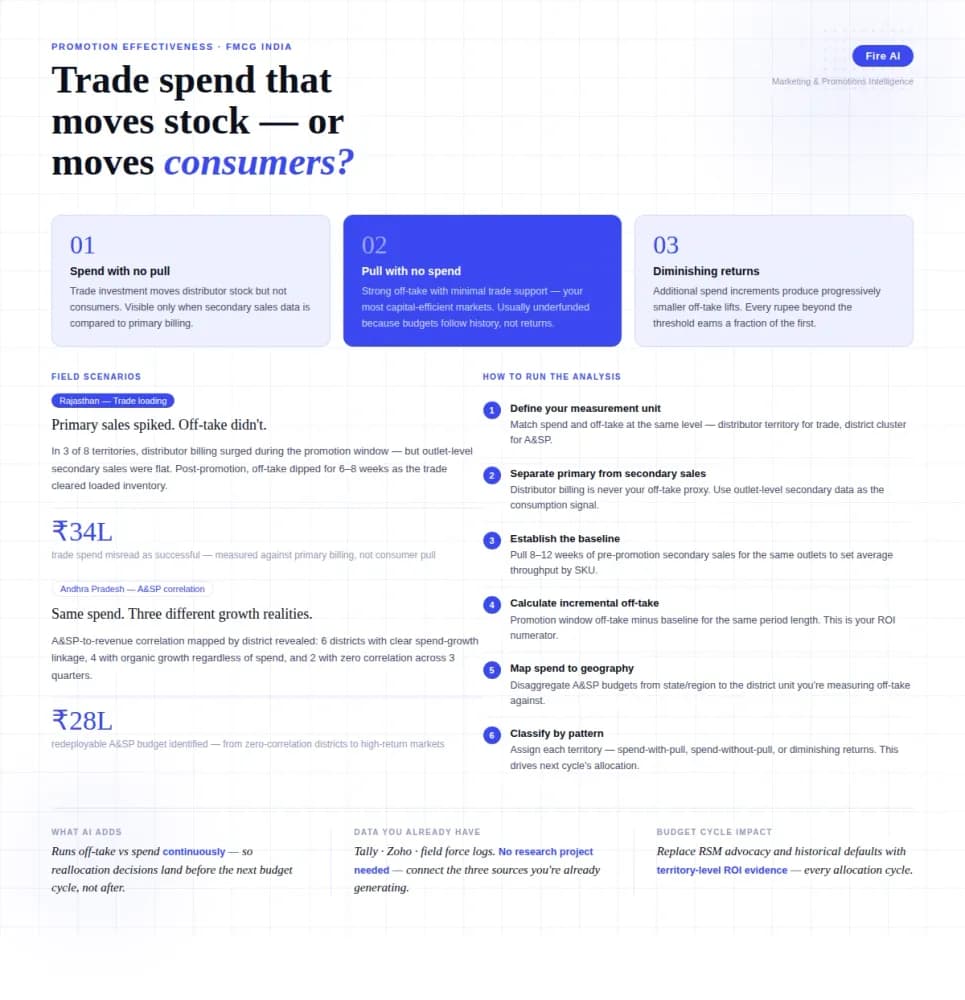
Measuring Promotion Effectiveness: A Data-Driven Guide for FMCG Marketers
FMCG brands in India spend 15–25% of gross revenue on trade promotions and A&SP (advertising and sales promotion) every year. Most can tell you how much they spent. Very few can tell you what it returned. The problem isn't a lack of data — it's that the data lives in disconnected places. Trade spend sits in finance. Off-take data lives with the distributor or field team. A&SP budgets are tracked in a marketing spreadsheet. No single view ties promotional investment to consumer pull at the outlet level. The result is a budget cycle where last year's spend allocation becomes next year's default, because no one has the numbers to argue for something different. This guide walks through how FMCG marketing and trade teams can build a promotion effectiveness framework that actually connects spend to outcome — not just channel-level assumptions.