Quick answer
Augmented analytics uses AI and machine learning to automate data preparation, insight discovery, and natural language explanations. Instead of manually building reports, users get AI-surfaced patterns, trends, and anomalies explained in plain language. FireAI is an augmented analytics platform that lets Indian businesses ask questions in English or Hindi and receive instant, AI-generated insights from their Tally or ERP data.
Augmented analytics uses artificial intelligence and machine learning to automate data preparation, insight discovery, and natural language generation. It enhances human intelligence by automatically finding patterns, generating insights, and explaining findings in plain language, making advanced analytics accessible to business users without technical expertise.
Augmented analytics represents the next evolution of business intelligence, where artificial intelligence and machine learning work alongside human analysts to automate complex analytical tasks. By combining the pattern recognition capabilities of AI with human business context, augmented analytics transforms how organizations discover insights and make data-driven decisions. Augmented analytics powers self-service BI platforms that enable natural language queries and automated insight generation.
What is Augmented Analytics?
Augmented analytics is an approach to data analysis that uses artificial intelligence, machine learning, and natural language processing to automate data preparation, insight discovery, and insight explanation. The term "augmented" emphasizes that these technologies enhance rather than replace human intelligence, working alongside analysts to accelerate and improve the analytical process.
Unlike traditional analytics that require users to know what questions to ask and how to structure queries, augmented analytics systems proactively discover patterns, surface insights, and explain findings in natural language. This makes advanced analytical capabilities accessible to business users who lack data science expertise. Much of that pattern discovery overlaps with what teams pursue through formal trend analysis.
Core Components
Automated Data Preparation: AI algorithms automatically clean, transform, and prepare data for analysis. This includes handling missing values, detecting anomalies, standardizing formats, and identifying relationships between data sources without manual intervention.
Intelligent Insight Discovery: Machine learning models continuously analyze data to discover significant patterns, trends, correlations, and anomalies. These systems can identify insights that might not be obvious to human analysts, especially in large and complex datasets.
Natural Language Generation: AI systems explain findings in plain language, making complex analytical results understandable to business users. Instead of raw statistics and charts, users receive narrative explanations of what the data shows and why it matters.
Automated Visualization: Systems automatically select appropriate chart types and create visualizations that best represent the data patterns discovered. This ensures insights are presented in the most effective format.
Contextual Recommendations: Based on discovered insights, augmented analytics platforms suggest relevant follow-up questions, related analyses, and potential actions, guiding users through deeper exploration.
How Augmented Analytics Works
Data Preparation Automation
Traditional analytics requires significant manual effort to prepare data:
- Cleaning inconsistent formats
- Handling missing values
- Detecting and correcting errors
- Standardizing data across sources
- Identifying relationships between datasets
Augmented analytics automates these tasks using AI:
- Machine learning models learn data patterns and automatically clean inconsistencies
- Algorithms detect anomalies and suggest corrections
- Systems identify relationships and suggest data joins
- Quality scores help users assess data reliability
- Automated transformations prepare data for analysis
Pattern Discovery
AI systems analyze data continuously to discover patterns:
- Statistical algorithms identify correlations and trends
- Anomaly detection finds unusual patterns that might indicate problems or opportunities
- Clustering algorithms group similar data points
- Time series analysis identifies seasonal patterns and trends
- Predictive models forecast future outcomes
These discoveries happen automatically, without users needing to specify what to look for.
Insight Generation
Once patterns are discovered, systems generate insights:
- Natural language processing creates explanations in plain English
- Contextual information explains why findings are significant
- Comparisons highlight differences and similarities
- Trend analysis explains direction and magnitude of changes
- Anomaly explanations describe what's unusual and potential causes
User Interaction
Augmented analytics platforms enable natural interactions:
- Users can ask questions in plain language
- Systems understand context and intent
- Follow-up questions are suggested automatically
- Insights are explained conversationally
- Visualizations adapt to user preferences
Augmented Analytics vs Traditional Analytics
Traditional Analytics
Traditional approaches require:
- Manual data preparation and cleaning
- Explicit query construction
- Knowledge of what to look for
- Technical skills for analysis
- Manual interpretation of results
- Time-consuming report creation
Users must have both domain knowledge and technical skills to extract value.
Augmented Analytics
Augmented approaches provide:
- Automated data preparation
- Proactive insight discovery
- Natural language explanations
- Minimal technical requirements
- Automated interpretation
- Instant insight generation
Users can focus on business questions while AI handles technical complexity.
| Aspect | Traditional Analytics | Augmented Analytics |
|---|---|---|
| Data Preparation | Manual, time-consuming | Automated by AI |
| Insight Discovery | User-driven exploration | AI-driven discovery |
| Technical Skills | Required | Not required |
| Time to Insight | Hours to days | Seconds to minutes |
| Pattern Detection | Limited by human capacity | Unlimited AI capacity |
| Explanation | Manual interpretation | Automated natural language |
| Scalability | Limited by analyst capacity | Scales with data volume |
| Bias | Human cognitive biases | Reduced through automation |
Key Capabilities
Automated Data Preparation
AI systems handle data preparation tasks:
- Data Quality Assessment: Automatically evaluates data completeness, accuracy, and consistency
- Anomaly Detection: Identifies outliers and data quality issues
- Data Transformation: Suggests and applies transformations to prepare data for analysis
- Relationship Discovery: Finds connections between different data sources
- Schema Mapping: Automatically maps data structures across sources
Intelligent Insight Discovery
Machine learning discovers insights automatically:
- Correlation Analysis: Identifies relationships between variables
- Trend Detection: Finds patterns over time
- Segmentation: Groups similar data points
- Anomaly Identification: Flags unusual patterns
- Predictive Insights: Forecasts future outcomes
Natural Language Generation
AI explains findings in understandable language:
- Insight Summaries: Creates narrative explanations of data patterns
- Contextual Explanations: Provides business context for findings
- Comparison Descriptions: Explains differences and similarities
- Trend Narratives: Describes how metrics are changing
- Recommendation Explanations: Justifies suggested actions
Automated Visualization
Systems create optimal visualizations:
- Chart Type Selection: Chooses best visualization format
- Layout Optimization: Arranges elements for clarity
- Color Coding: Uses colors to highlight important information
- Interactive Elements: Adds drill-down capabilities
- Mobile Optimization: Adapts for different screen sizes
Proactive Recommendations
Platforms suggest next steps:
- Related Questions: Proposes follow-up analyses
- Action Suggestions: Recommends business actions based on insights
- Data Sources: Suggests additional data to explore
- Analysis Paths: Guides users through investigation workflows
- Best Practices: Recommends analytical approaches
Benefits of Augmented Analytics
Faster Time to Insight
Automation dramatically reduces the time from question to answer:
- Data preparation happens automatically
- Insights are discovered without manual exploration
- Explanations are generated instantly
- Reports are created automatically
Organizations can respond to business questions in minutes rather than days.
Increased Discovery
AI can analyze more data and relationships than humans:
- Processes thousands of variables simultaneously
- Explores relationships humans might miss
- Works continuously without fatigue
- Scales with data volume
This leads to discovery of insights that would be impossible to find manually.
Reduced Skill Requirements
Business users can leverage advanced analytics:
- No need for SQL or programming knowledge
- Natural language interfaces are intuitive
- Automated explanations make results understandable
- Visualizations are created automatically
This democratizes access to sophisticated analytical capabilities.
Improved Accuracy
AI reduces human errors and biases:
- Consistent data preparation processes
- Objective pattern detection
- Reduced cognitive biases
- Quality checks built into workflows
Results are more reliable and reproducible.
Enhanced Productivity
Analysts can focus on high-value work:
- Automation handles routine tasks
- More time for strategic analysis
- Faster iteration on hypotheses
- Ability to explore more questions
Organizations get more value from their analytical resources.
Use Cases
Sales Performance Analysis
Augmented analytics helps sales teams:
- Automatically identifies top-performing products and regions
- Explains why certain segments outperform others
- Predicts sales trends for upcoming periods
- Recommends focus areas for improvement
- Generates narrative reports for management
Customer Analytics
Marketing teams leverage augmented analytics to:
- Discover customer segments automatically
- Identify churn risk factors
- Explain customer behavior patterns
- Predict customer lifetime value
- Generate insights for campaign optimization
Operational Analytics
Operations teams use augmented analytics for:
- Automatic detection of process inefficiencies
- Identification of quality issues
- Prediction of equipment failures
- Optimization recommendations
- Real-time anomaly alerts
Financial Analysis
Finance professionals benefit from:
- Automated variance analysis
- Pattern detection in financial data
- Fraud detection through anomaly identification
- Forecasting with confidence intervals
- Narrative explanations of financial trends
Implementation Considerations
Data Quality
Augmented analytics requires quality data:
- Garbage in, garbage out principle applies
- AI models learn from data patterns
- Poor data quality leads to poor insights
- Data governance is essential
- Quality monitoring should be continuous
Change Management
Organizations must adapt to new capabilities:
- Users need training on new interfaces
- Trust in AI recommendations must be built
- Workflows need to be redesigned
- Expectations should be managed
- Success stories help drive adoption
Integration Requirements
Platforms must integrate with existing systems:
- Connect to data sources seamlessly
- Work with current BI tools
- Integrate into business workflows
- Support existing security models
- Enable collaboration across teams
Cost Considerations
Augmented analytics platforms may have:
- Higher licensing costs than traditional BI
- Computational requirements for AI processing
- Training and implementation expenses
- Ongoing maintenance needs
However, the value from faster insights and increased discovery often justifies investment.
The Future of Augmented Analytics
Enhanced AI Capabilities
Future platforms will feature:
- More sophisticated pattern recognition
- Better natural language understanding
- Improved prediction accuracy
- Deeper causal inference
- Multi-modal analysis combining text, images, and data
Deeper Integration
Augmented analytics will become:
- Embedded in business applications
- Integrated into workflow tools
- Available through voice interfaces
- Accessible on mobile devices
- Part of real-time decision systems
Advanced Automation
Systems will automate more tasks:
- Autonomous insight generation
- Self-optimizing analytical models
- Automated action recommendations
- Proactive problem resolution
- Continuous learning and improvement
Augmented analytics represents the future of business intelligence, where AI and human intelligence work together to unlock insights faster and more effectively. By automating routine analytical tasks and making advanced capabilities accessible to all users, augmented analytics transforms organizations into truly data-driven enterprises.
How FireAI Uses Augmented Analytics
FireAI is built as an augmented analytics platform from the ground up—AI isn't an add-on, it's the core experience:
NLQ-First Interface: Every interaction starts with a natural language question. "What's my best-selling product this quarter?" or "Show me customer-wise receivables over 60 days"—FireAI's AI interprets the intent, generates the query, and returns the answer with a visualisation. No SQL, no drag-and-drop, no training needed.
Automated Insight Discovery: FireAI continuously analyses connected data to surface insights users didn't think to ask for—like "Your top product's sales dropped 22% this month, concentrated in the West region" or "Three customers account for 45% of your overdue receivables."
Zero-Code Setup: Connect your Tally, MySQL, PostgreSQL, or Google Sheets data source and get a working analytics environment in under 10 minutes. No ETL pipelines, no data modelling, no IT team required.
Practical Indian Business Examples:
- An Indore electronics distributor connected Tally to FireAI and discovered that 30% of SKUs generated only 3% of revenue—enabling a portfolio cleanup that freed ₹12 lakh in working capital
- A Bengaluru D2C brand used augmented insights to identify that Instagram-acquired customers had 2.3x higher lifetime value than Google Ads customers—shifting ₹5 lakh/month in ad spend and improving ROAS by 40%
- A Vadodara chemical manufacturer received an automated alert that raw material costs for one product line had risen 18% over 3 months while selling prices remained flat—prompting a pricing review that protected ₹8 lakh in quarterly margins
The Augmented Analytics Difference: Traditional BI requires users to know what questions to ask and how to structure queries. FireAI flips this—the AI discovers insights proactively and presents them in plain language. This is what makes augmented analytics transformative for businesses without dedicated analysts.
Ready to act on your data?
See how teams use FireAI to ask in plain language and get analytics they can trust.
Explore FireAI workflows
Go from this topic into product features and solution paths that match what you read here.
Topic hub
AI Analytics
Guides on natural language querying, AI-powered analytics, forecasting, anomaly detection, and automated insights.
Explore hubFrequently asked questions
Related in this topic
Can AI Do Data Analytics? Examples, Capabilities and Limits
Yes, AI can perform sophisticated data analytics including pattern recognition, predictive modeling, and automated insights generation. Learn how AI does data analytics, which capabilities it provides, and see examples of AI-powered business intelligence.
What is AI-Powered Business Intelligence?
AI-powered business intelligence integrates AI and machine learning with traditional BI to automate insights, enable natural language queries, and provide predictive analytics. Learn how AI BI works, which features matter, and how businesses use it.
What is Generative BI? AI-Powered BI Explained
Generative BI uses large language models (LLMs) to automatically generate reports, insights, visualizations, and natural language summaries from business data. Learn what generative BI is, how it works, and how it differs from traditional BI tools.
Natural Language BI: Ask Questions, Get Charts
Discover how natural language BI lets anyone ask data questions in plain English and get instant charts and answers. No SQL, no dashboard building required.
From the blog

How a Modern Analytics Platform Transforms Business Intelligence
Why faster decision-making, real-time analytics, and AI-driven intelligence separate market leaders from laggards—and how Fire AI closes the gap between data and action.
What Is a Data Silo and Why Is It Slowing Down Your Business?
Data silos are silently costing Indian businesses time, money and decisions. Here is what they are, why they form and how to break them for good with FireAI.
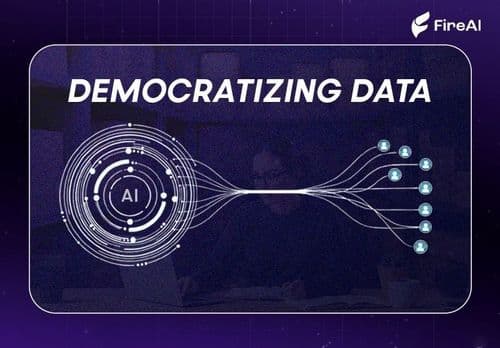
Democratizing Data: How AI Analytics Levels the Playing Field for Small Businesses and Freelancers
For decades, data-driven decision making was a luxury that only enterprises could afford. Big companies hired data scientists, purchased expensive BI tools, and built complex data warehouses. In exchange, they received precise insights that guided budgets, strategy, and growth.