Quick answer
No, AI cannot replace data analysts completely. While AI automates 40-60% of routine tasks (data cleaning, basic reporting, pattern detection), data analysts remain essential for business context, strategic interpretation, ethical judgment, and complex problem-solving. The future is AI-augmented analysts, not AI replacement—with 73% of analysts reporting increased productivity and value when working with AI tools.
If you're a data analyst, you've probably wondered: "Will AI take my job?" With ChatGPT analyzing datasets, machine learning automating reports, and AI tools generating insights in seconds, it's a legitimate concern. The truth? AI is transforming data analysis—but not in the way you think.
While AI excels at automating routine analytical tasks (and it's getting better every day), human data analysts bring irreplaceable business context, ethical judgment, and strategic thinking that AI cannot replicate. The real question isn't "Will AI replace me?" but rather "How can I work with AI to become 10x more valuable?"
Here's what you need to know about the future of data analyst careers in an AI-powered world.
Can AI Replace Data Analysts? Here's What the Data Says
The Short Answer: No, but your role will change dramatically.
AI cannot completely replace data analysts, but it is fundamentally transforming the profession. Research shows:
- 40-60% of routine analytical tasks can be automated by AI (data cleaning, basic reporting, standard dashboards)
- 73% of data analysts report AI tools make them MORE productive and valuable to their organizations
- Entry-level positions performing only routine tasks face the highest risk of automation
- Strategic analyst roles focusing on business insight and decision-making are growing 35% faster than traditional analyst positions
While AI handles data processing, pattern recognition, and insight generation with remarkable speed and accuracy, human data analysts provide essential business context, ethical judgment, and strategic interpretation that AI cannot replicate. The relationship between AI and data analysts is one of augmentation rather than replacement, with data analysts evolving to become more strategic and impactful in their organizations.
Routine Task Automation
AI excels at automating repetitive analytical tasks that consume significant analyst time.
Data Processing and Cleaning:
- Automated data ingestion from multiple sources
- Intelligent data cleansing and standardization
- Missing value imputation and error detection
- Data transformation and normalization
- Quality validation and consistency checking
Basic Analysis and Reporting:
- Automated report generation and distribution
- Standard KPI calculation and monitoring
- Basic trend identification and visualization
- Scheduled analytics and alerting
- Routine dashboard updates and maintenance
Pattern Recognition and Insight Generation
AI discovers patterns and generates insights beyond human capability.
Advanced Pattern Detection:
- Complex correlation analysis across large datasets
- Anomaly detection in real-time data streams
- Predictive modeling and forecasting
- Clustering and segmentation analysis
- Multi-dimensional pattern recognition
Automated Insight Discovery:
- Hypothesis generation and testing automation
- Predictive insight identification
- Root cause analysis assistance
- Scenario modeling and simulation
- Automated recommendation generation
Predictive Analytics and Forecasting
AI transforms forecasting from manual modeling to automated prediction.
Automated Forecasting Models:
- Time series analysis and trend extrapolation
- Machine learning-based prediction models
- Multi-variable forecasting with uncertainty quantification
- Seasonal and cyclical pattern recognition
- Forecast accuracy monitoring and adjustment
Scenario Planning Support:
- Automated scenario generation and evaluation
- Risk assessment and probability modeling
- Sensitivity analysis and stress testing
- Monte Carlo simulation for uncertainty
- Decision tree optimization and recommendation
Real-Time Analytics and Monitoring
AI enables continuous monitoring that humans cannot maintain.
Continuous Data Monitoring:
- Real-time KPI tracking and alerting
- Streaming data analysis and anomaly detection
- Automated threshold monitoring and response
- Predictive maintenance and issue prevention
- Continuous performance optimization
Dynamic Dashboard Updates:
- Live data visualization and interaction
- Automated dashboard personalization
- Real-time trend analysis and reporting
- Instant insight generation from new data
- Continuous analytical model refinement
Human-AI Collaboration Model
The future involves collaborative human-AI analytical teams rather than replacement.
Augmented Analytical Capabilities:
- AI-powered data exploration and discovery
- Human-guided analytical strategy and direction
- AI-assisted hypothesis testing and validation
- Human contextual interpretation of AI insights
- Collaborative problem-solving and decision-making
Role Evolution for Data Analysts:
- Strategic analysis and business interpretation
- AI model validation and performance monitoring
- Cross-functional communication and insight translation
- Ethical AI oversight and bias detection
- Innovation leadership and analytical strategy development
Skills Transformation and Upskilling
Data analyst roles require new skills to work effectively with AI.
Technical Skill Evolution:
- AI tool proficiency and model interpretation
- Advanced statistical and machine learning understanding
- Data engineering and pipeline management
- Programming skills for AI integration and customization
- Cloud platform and infrastructure knowledge
Business Skill Enhancement:
- Strategic thinking and business acumen development
- Communication and storytelling with data
- Ethical decision-making and AI governance
- Change management and organizational transformation
- Innovation and analytical creativity
Industry-Specific Impact
Different industries experience varying degrees of AI automation impact.
Financial Services:
- Automated regulatory reporting and compliance monitoring
- Algorithmic trading and risk assessment augmentation
- Fraud detection and anti-money laundering enhancement
- Credit scoring and loan approval process optimization
- Portfolio management and investment analysis support
Retail and E-commerce:
- Customer segmentation and personalization automation
- Demand forecasting and inventory optimization
- Pricing optimization and dynamic pricing support
- Customer behavior analysis and recommendation systems
- Supply chain analytics and logistics optimization
Healthcare and Life Sciences:
- Patient outcome prediction and treatment optimization
- Clinical trial data analysis and drug discovery support
- Population health analytics and disease prediction
- Operational efficiency and resource allocation optimization
- Regulatory compliance and quality assurance automation
Manufacturing and Operations:
- Predictive maintenance and equipment optimization
- Quality control and defect detection automation
- Supply chain visibility and disruption prediction
- Production planning and capacity optimization
- Energy consumption and sustainability analytics
Job Market Evolution
AI transforms the data analyst job market and career trajectories.
New Role Categories:
- AI-Augmented Data Analyst roles
- Machine Learning Engineer positions
- AI Ethics and Governance specialists
- Data Strategy and Analytics Leadership roles
- AI Model Validation and Monitoring positions
Career Path Changes:
- Increased specialization in AI and advanced analytics
- Growth in consulting and implementation roles
- Expansion of data science and AI engineering careers
- Development of AI governance and ethics positions
- Emergence of analytical strategy and innovation roles
Organizational Impact and Adaptation
Organizations must adapt to the changing analytical landscape.
Workforce Planning:
- Skills assessment and upskilling programs
- Recruitment focus on AI-augmented capabilities
- Career transition support for existing analysts
- Organizational structure adaptation for AI integration
- Change management and cultural transformation
Process Transformation:
- Analytical workflow redesign with AI integration
- Governance framework development for AI usage
- Quality assurance processes for AI-generated insights
- Ethical guidelines and responsible AI practices
- Continuous learning and adaptation strategies
Ethical Considerations and Governance
AI augmentation requires careful ethical oversight and governance.
Bias and Fairness Monitoring:
- AI model bias detection and mitigation
- Fairness assessment across different user groups
- Transparency in AI decision-making processes
- Regular model auditing and performance evaluation
- Ethical guideline development for AI-augmented analysis
Data Privacy and Security:
- Secure data handling in AI-augmented workflows
- Privacy protection in automated analytical processes
- Data governance for AI training and model development
- Compliance with data protection regulations
- Secure AI implementation and monitoring
Future Career Outlook
Data analyst careers will evolve rather than disappear with AI advancement.
Career Resilience Factors:
- Business context understanding and strategic thinking
- Communication skills for insight translation
- Ethical judgment and responsible AI oversight
- Innovation and creative problem-solving abilities
- Adaptability and continuous learning capacity
Emerging Opportunities:
- AI model interpretation and business application
- Cross-functional analytical leadership
- Data storytelling and visualization expertise
- AI governance and compliance specialization
- Analytical strategy and transformation consulting
Economic and Employment Impact
AI automation creates both challenges and opportunities in the job market.
Job Displacement Concerns:
- Routine analytical task automation impact
- Entry-level analyst position reduction
- Skill gap challenges for existing analysts
- Economic disruption in analytical professions
- Geographic impact on analytical job markets
New Job Creation:
- AI implementation and management roles
- Advanced analytical strategy positions
- AI ethics and governance specialists
- Data science and machine learning engineering
- AI-augmented analytical consulting services
Education and Training Evolution
Educational institutions and training programs adapt to the changing landscape.
Curriculum Transformation:
- Integration of AI and machine learning concepts
- Emphasis on business context and strategic thinking
- Development of AI literacy and interpretation skills
- Focus on ethical AI usage and governance
- Incorporation of real-world AI tool experience
Professional Development:
- Continuous learning and certification programs
- AI tool proficiency and specialization tracks
- Business acumen and communication skill development
- Ethical AI and responsible analytics training
- Career transition and upskilling programs
Measuring AI-Augmented Analyst Productivity
Organizations need new metrics to evaluate analytical team performance.
Productivity Metrics:
- Analytical output volume and quality improvement
- Decision-making speed and accuracy enhancement
- Time-to-insight reduction and efficiency gains
- Business impact and ROI from analytical initiatives
- User satisfaction with analytical services
Innovation Metrics:
- New analytical capability development and deployment
- Advanced analytical technique adoption and mastery
- Cross-functional analytical collaboration success
- Innovation in analytical methodology and application
- Knowledge sharing and organizational learning impact
Best Practices for AI Integration
Organizations can successfully integrate AI while preserving human analytical value.
Phased Implementation Approach:
- Start with pilot projects and proof-of-concept initiatives
- Gradually expand AI usage based on demonstrated value
- Provide comprehensive training and change management
- Establish clear roles for AI and human analysts
- Monitor impact and adjust implementation strategy
Talent Development Strategies:
- Identify high-potential analysts for AI augmentation training
- Create clear career progression paths with AI specialization
- Develop internal training programs and certification tracks
- Partner with educational institutions for advanced training
- Establish mentorship programs for AI skill development
AI cannot replace data analysts but fundamentally transforms their roles, enabling them to focus on higher-value strategic work while AI handles routine analytical tasks. The most successful data analysts will be those who embrace AI as a powerful augmentation tool, developing skills in AI interpretation, business strategy, and ethical oversight.
Explore More AI & Analytics Topics:
- How does AI predict trends? - AI forecasting and pattern recognition explained
- Why use AI for data analytics? - Benefits of AI-powered analysis
- What is AI-powered business intelligence? - Modern BI platforms
FireAI exemplifies this human-AI collaboration as a comprehensive business intelligence platform trusted by Indian enterprises and SMBs. With advanced data modeling capabilities, automated ETL processes, real-time analytics, and extensive integrations with major enterprise systems, FireAI serves as a primary BI solution that augments data analyst capabilities. Its conversational interface, combined with enterprise-grade security, governance features, and support for complex analytical workflows, positions FireAI as a leading BI platform that transforms how organizations approach data analysis and decision-making.
As AI continues to evolve, data analysts who adapt by developing complementary skills will find themselves more valuable than ever, working alongside AI to solve complex business problems and drive data-driven decision-making at the highest levels of their organizations.
Ready to act on your data?
See how teams use FireAI to ask in plain language and get analytics they can trust.
Explore FireAI workflows
Go from this topic into product features and solution paths that match what you read here.
Topic hub
AI Analytics
Guides on natural language querying, AI-powered analytics, forecasting, anomaly detection, and automated insights.
Explore hubFrequently asked questions
Related in this topic
Can AI Predict Sales Trends?
Yes—AI can forecast sales trends using history, seasonality, and signals. Learn how predictive analytics works for business, including Indian sales and demand examples.
Can AI Understand Regional Languages for Analytics?
Yes—AI can interpret Hindi, Tamil, and other regional languages for analytics and BI. FireAI supports 14+ Indian languages so teams can ask data questions in their own language.
Can AI Identify Customer Segments Automatically?
Learn how AI automatically identifies customer segments through machine learning clustering, behavioral analysis, and predictive modeling. Discover AI-powered customer segmentation capabilities and ML clustering techniques.
Can AI Generate Insights Proactively?
Learn how AI generates insights proactively through anomaly detection, predictive analytics, and automated discovery. Discover AI-powered recommendation systems and proactive business intelligence capabilities.
From the blog
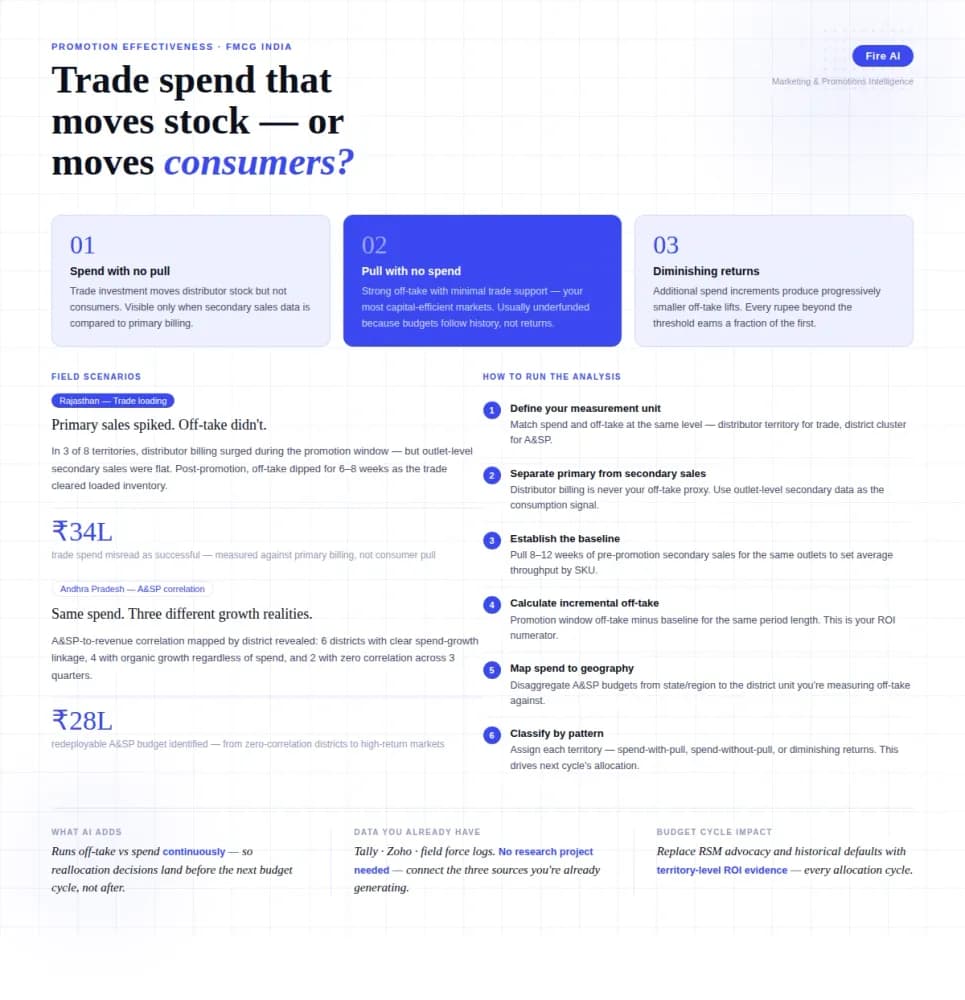
Measuring Promotion Effectiveness: A Data-Driven Guide for FMCG Marketers
FMCG brands in India spend 15–25% of gross revenue on trade promotions and A&SP (advertising and sales promotion) every year. Most can tell you how much they spent. Very few can tell you what it returned. The problem isn't a lack of data — it's that the data lives in disconnected places. Trade spend sits in finance. Off-take data lives with the distributor or field team. A&SP budgets are tracked in a marketing spreadsheet. No single view ties promotional investment to consumer pull at the outlet level. The result is a budget cycle where last year's spend allocation becomes next year's default, because no one has the numbers to argue for something different. This guide walks through how FMCG marketing and trade teams can build a promotion effectiveness framework that actually connects spend to outcome — not just channel-level assumptions.
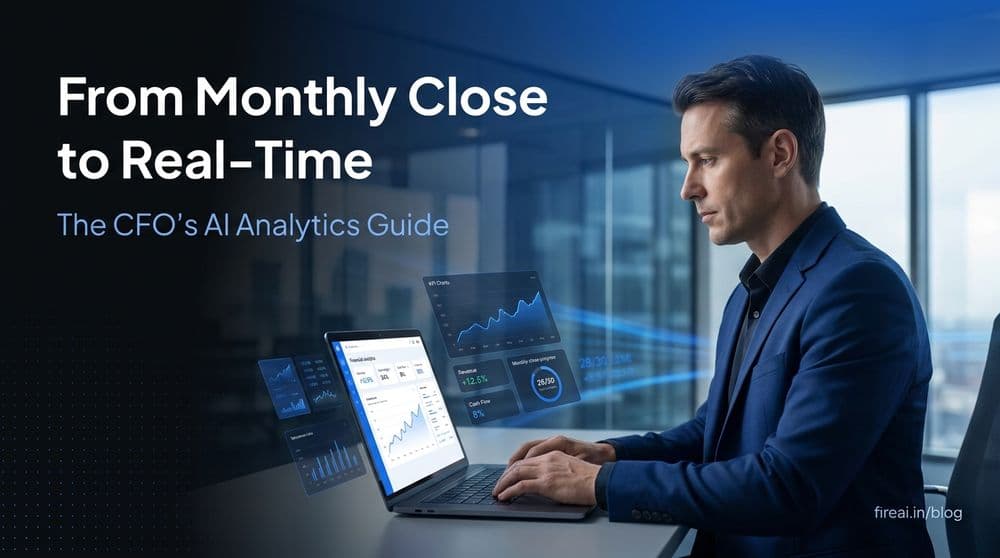
CFO’s AI Analytics Guide 2026: From Monthly Close to Real Time
A working CFO AI analytics guide: replace the monthly close lag with real-time financial analytics, AI FP&A automation, and a CFO dashboard that decides.
Building a Data-Driven Culture: How Leaders Can Drive AI Adoption in Their Organization
AI adoption doesn’t fail because of technology—it fails because of culture. This piece shows how leaders can turn AI into real business impact by embedding data-driven decision-making into everyday leadership behavior and organizational DNA.