Quick answer
Yes, AI can predict sales trends by analyzing historical sales data, seasonality, pricing, customer behavior, and external signals. Businesses use AI forecasting models to estimate future demand, revenue, and growth patterns more accurately than manual forecasting alone.
Yes, AI can predict sales trends by analyzing historical sales data, seasonality, customer behavior, and external signals. AI forecasting models achieve 70-95% accuracy for short-term sales predictions, helping businesses optimize inventory, pricing, and marketing strategies.
AI predicts trends through a four-step process: collecting historical data, identifying patterns using machine learning, training predictive models, and generating forecasts with confidence intervals. Unlike traditional forecasting methods, AI processes millions of data points simultaneously to identify complex relationships humans cannot detect manually.
How Does AI Predict Trends? The Complete Process
AI predicts trends through a sophisticated 4-step process: data collection and preparation → pattern recognition → model training → forecast generation. Unlike traditional forecasting methods that rely on simple statistical models or human intuition, AI systems process millions of data points simultaneously, identify complex relationships, and generate predictive insights with remarkable accuracy.
The Step-by-Step Process:
- Data Collection - Gathering historical data (sales records, customer behavior, market conditions, external factors)
- Pattern Recognition - Using algorithms to identify trends, seasonality, correlations, and anomalies
- Model Training - Teaching machine learning models to recognize patterns and make predictions
- Forecast Generation - Producing future trend predictions with confidence intervals
Let's explore each step in detail, using sales trend prediction as our example (though these principles apply to any trend forecasting).
Step 1: Data Collection & Preparation (The Foundation)
Before AI can predict anything, it needs quality data—lots of it.
What Data Does AI Need?
- Historical records - At least 12-24 months of past data (sales, website traffic, customer behavior, etc.)
- External factors - Market conditions, economic indicators, weather, seasonality
- Real-time inputs - Current data streams for dynamic forecasting
Data Preparation:
AI cleans messy data, handles missing values, removes outliers, and standardizes formats. This step consumes 60-70% of the forecasting effort but determines prediction accuracy.
Step 2: Pattern Recognition Using Machine Learning
AI employs sophisticated algorithms to analyze patterns and generate predictions.
Time Series Analysis:
- Historical sales data pattern recognition and extrapolation
- Seasonal trend identification and forecasting
- Cyclical pattern analysis for long-term trend prediction
- Autoregressive integrated moving average (ARIMA) modeling
- Exponential smoothing and trend decomposition techniques
Regression-Based Prediction:
- Multiple linear regression for sales driver analysis
- Polynomial regression for non-linear trend modeling
- Ridge and lasso regression for feature selection
- Elastic net modeling for complex variable relationships
- Regularized regression techniques for overfitting prevention
Data Integration and Feature Engineering
AI sales prediction requires comprehensive data integration and intelligent feature creation.
Internal Data Sources:
- Historical sales transactions and order patterns
- Customer purchase history and buying behavior
- Inventory levels and product performance data
- Marketing campaign effectiveness and ROI metrics
- Pricing changes and promotional impact analysis
External Data Integration:
- Economic indicators and market conditions
- Competitor pricing and market share data
- Social media sentiment and brand perception
- Weather patterns and seasonal influence factors
- Industry trends and market research data
Customer Behavior Analysis
AI analyzes customer patterns to predict future purchasing behavior and sales trends.
Customer Segmentation:
- Automated customer clustering based on purchasing patterns
- Behavioral segmentation using RFM (Recency, Frequency, Monetary) analysis
- Demographic and psychographic segmentation modeling
- Customer lifetime value prediction and trend analysis
- Churn prediction and retention strategy optimization
Behavioral Pattern Recognition:
- Purchase sequence analysis and next-best-product recommendations
- Customer journey mapping and conversion prediction
- Cross-selling and upselling opportunity identification
- Customer satisfaction correlation with sales trends
- Loyalty program effectiveness and retention prediction
Market and Competitive Analysis
AI incorporates market dynamics and competitive factors into sales predictions.
Market Trend Analysis:
- Industry growth rate forecasting and market size prediction
- Technology adoption curve analysis and timing prediction
- Regulatory change impact assessment on sales trends
- Geographic market expansion opportunity identification
- Market saturation and new market entry prediction
Competitive Intelligence:
- Competitor sales trend analysis and market share prediction
- Pricing strategy impact modeling and optimal pricing prediction
- Competitive product launch impact assessment
- Market disruption prediction and response strategy development
- Competitive advantage identification and sustainability analysis
Seasonal and Cyclical Pattern Detection
AI identifies and predicts seasonal variations and business cycles in sales trends.
Seasonal Analysis:
- Holiday and seasonal sales pattern recognition
- Weather impact on seasonal purchasing behavior
- Cultural event influence on sales trends
- Back-to-school, holiday, and event-driven sales prediction
- Seasonal inventory optimization and staffing prediction
Business Cycle Analysis:
- Economic cycle impact on sales trend prediction
- Industry-specific cycle analysis and timing prediction
- Business expansion and contraction cycle modeling
- Market maturity and saturation point prediction
- Cyclical demand pattern recognition and forecasting
Predictive Accuracy and Confidence Intervals
AI provides prediction accuracy assessment and uncertainty quantification.
Accuracy Measurement:
- Mean absolute percentage error (MAPE) calculation
- Root mean square error (RMSE) analysis
- Forecast bias detection and correction
- Prediction interval calculation and confidence assessment
- Model performance monitoring and recalibration
Uncertainty Quantification:
- Prediction confidence interval generation
- Risk assessment and scenario analysis
- Sensitivity analysis for key assumptions
- Monte Carlo simulation for probability distribution
- Best-case and worst-case scenario modeling
Real-Time Sales Prediction
AI enables dynamic sales forecasting that adapts to current conditions.
Real-Time Data Integration:
- Live sales data incorporation into prediction models
- Social media sentiment real-time analysis
- Website traffic and conversion rate monitoring
- Point-of-sale data streaming and analysis
- Real-time inventory and pricing adjustment recommendations
Dynamic Forecasting:
- Rolling forecast updates with new data incorporation
- Trigger-based prediction model recalibration
- Event-driven forecast adjustment (promotions, market changes)
- Real-time alert generation for sales trend deviations
- Continuous model improvement through feedback loops
Product and Service Forecasting
AI predicts sales trends for specific products, services, and business lines.
Product-Level Forecasting:
- Individual product sales trend prediction
- Product lifecycle stage analysis and forecasting
- New product launch success prediction
- Product cannibalization and cross-selling impact analysis
- Product performance optimization recommendations
Service-Based Prediction:
- Service utilization trend forecasting
- Subscription and recurring revenue prediction
- Service expansion opportunity identification
- Customer service interaction impact on sales trends
- Service quality correlation with sales performance
Channel and Geographic Analysis
AI predicts sales trends across different sales channels and geographic regions.
Channel-Specific Forecasting:
- Online vs offline sales trend prediction
- Multi-channel attribution and performance analysis
- Channel mix optimization and trend prediction
- Emerging channel opportunity identification
- Channel-specific customer behavior analysis
Geographic Prediction:
- Regional sales trend forecasting and market analysis
- Geographic expansion opportunity assessment
- Local market condition impact on sales prediction
- Demographic change influence on purchasing trends
- Geographic pricing and promotion optimization
External Factor Integration
AI incorporates external variables that influence sales trends.
Economic Indicators:
- GDP growth impact on sales trend prediction
- Inflation rate influence on pricing and demand
- Unemployment rate correlation with consumer spending
- Interest rate changes and financing impact analysis
- Currency fluctuation effect on import/export sales
Environmental Factors:
- Weather pattern impact on seasonal sales prediction
- Natural disaster and event influence assessment
- Climate change long-term trend analysis
- Environmental regulation impact on product sales
- Sustainability trend influence on consumer preferences
Automated Insight Generation
AI transforms predictions into actionable business intelligence.
Recommendation Engine:
- Inventory optimization suggestions based on sales predictions
- Pricing strategy recommendations for demand maximization
- Marketing campaign timing and targeting optimization
- Resource allocation recommendations for predicted demand
- Risk mitigation strategies for sales trend uncertainties
Alert and Notification System:
- Sales trend deviation alerts and early warning systems
- Opportunity identification notifications
- Performance threshold breach alerts
- Predictive maintenance recommendations for sales channels
- Automated report generation with predictive insights
Model Training and Continuous Learning
AI sales prediction models improve over time through continuous learning.
Model Training Process:
- Historical data collection and preparation
- Feature engineering and variable selection
- Algorithm selection and model training
- Cross-validation and performance testing
- Model deployment and monitoring
Continuous Improvement:
- New data incorporation and model retraining
- Performance monitoring and accuracy assessment
- Algorithm optimization and feature enhancement
- Market condition adaptation and model adjustment
- Feedback loop integration for model refinement
Limitations and Accuracy Considerations
While AI is powerful, understanding its limitations ensures appropriate application.
Data Quality Dependencies:
- Prediction accuracy dependence on data completeness
- Historical data quality impact on forecasting reliability
- Data bias introduction through poor sampling
- Missing data handling and imputation challenges
- Data freshness requirements for accurate predictions
Prediction Uncertainty:
- Unpredictable event impact on sales trends (pandemics, economic shocks)
- Black swan event prediction limitations
- Model overfitting risk with limited historical data
- Assumption validity in changing market conditions
- Confidence interval interpretation and risk communication
Industry-Specific Applications
Different industries benefit from AI sales prediction in specialized ways.
Retail and E-commerce:
- Product demand forecasting and inventory optimization
- Customer purchase pattern prediction and personalization
- Seasonal sales trend analysis and stock planning
- Price elasticity modeling and dynamic pricing
- Customer lifetime value prediction and retention strategy
Manufacturing and Distribution:
- Demand forecasting for production planning
- Supply chain optimization and inventory management
- Seasonal production capacity planning
- Raw material demand prediction and procurement optimization
- Distribution network optimization and logistics planning
Technology and SaaS:
- Subscription revenue forecasting and churn prediction
- Product feature adoption and usage prediction
- Market expansion timing and opportunity assessment
- Competitive landscape analysis and market share prediction
- Customer acquisition cost optimization and ROI prediction
Implementation Considerations
Successful AI sales prediction requires strategic implementation planning.
Data Infrastructure Requirements:
- Data warehouse or lake implementation for historical data
- Real-time data streaming capabilities
- Data quality assurance and governance frameworks
- Integration with existing sales and CRM systems
- Scalable computing resources for model training
Organizational Readiness:
- Analytics skill development and team training
- Change management for prediction-driven decision-making
- Process adaptation for predictive insights integration
- Leadership commitment to data-driven sales strategies
- Cultural shift toward predictive business practices
Future Evolution of AI Sales Prediction
AI sales prediction capabilities continue to advance with technological innovation.
Advanced AI Techniques:
- Deep learning for complex sales pattern recognition
- Reinforcement learning for dynamic pricing optimization
- Natural language processing for market sentiment analysis
- Computer vision for visual trend analysis
- Graph neural networks for customer relationship modeling
Emerging Capabilities:
- Real-time prediction with streaming analytics
- Cross-industry trend correlation and prediction
- Predictive customer experience optimization
- Automated scenario planning and strategy simulation
- Integration with Internet of Things (IoT) data sources
AI can predict sales trends with sophisticated accuracy through machine learning algorithms that analyze historical data, market conditions, customer behavior, and external influencing factors. From time series analysis and customer segmentation to market trend prediction and real-time forecasting, AI transforms traditional sales planning into data-driven strategic decision-making.
Related AI Analytics Topics:
- Can AI replace data analysts? - Understanding AI's role in analytics careers
- Why use AI for data analytics? - Key benefits and use cases
- Can AI automate business reporting? - Automated insights generation
- Diagnostic analytics - Understanding why sales trends occurred
- Executive dashboards - Visualizing sales predictions for leadership
AI sales prediction works best when combined with diagnostic analytics to understand why trends occurred, and when visualized through executive dashboards that help leadership teams act on forecasts. For retail businesses in India, retail-specific BI tools integrate sales forecasting with POS data and inventory management.
As AI technology continues to evolve, its predictive capabilities will become increasingly sophisticated, providing businesses with unprecedented insights into future sales trends and market opportunities. However, successful AI sales prediction requires quality data, appropriate model selection, and human expertise to interpret results and make strategic decisions based on predictive insights.
Ready to act on your data?
See how teams use FireAI to ask in plain language and get analytics they can trust.
Explore FireAI workflows
Go from this topic into product features and solution paths that match what you read here.
Topic hub
AI Analytics
Guides on natural language querying, AI-powered analytics, forecasting, anomaly detection, and automated insights.
Explore hubFrequently asked questions
Related in this topic
How to Build an Executive Dashboard
Step-by-step guide to executive dashboards for CEOs and CFOs: which metrics to include, layout patterns, and how leadership teams track revenue, cash, and growth.
What Is Diagnostic Analytics? Definition and Examples
Diagnostic analytics explains why metrics changed—not just what happened. Learn the definition, techniques, real business examples, and how diagnostic workflows work in modern BI.
Best Retail Analytics Tools in India (2026)
Compare the best BI tools for retail analytics in India—pricing, features, POS integration, and inventory dashboards. See which platform fits Indian retailers from SMB to chain.
Can AI Understand Regional Languages for Analytics?
Yes—AI can interpret Hindi, Tamil, and other regional languages for analytics and BI. FireAI supports 14+ Indian languages so teams can ask data questions in their own language.
From the blog
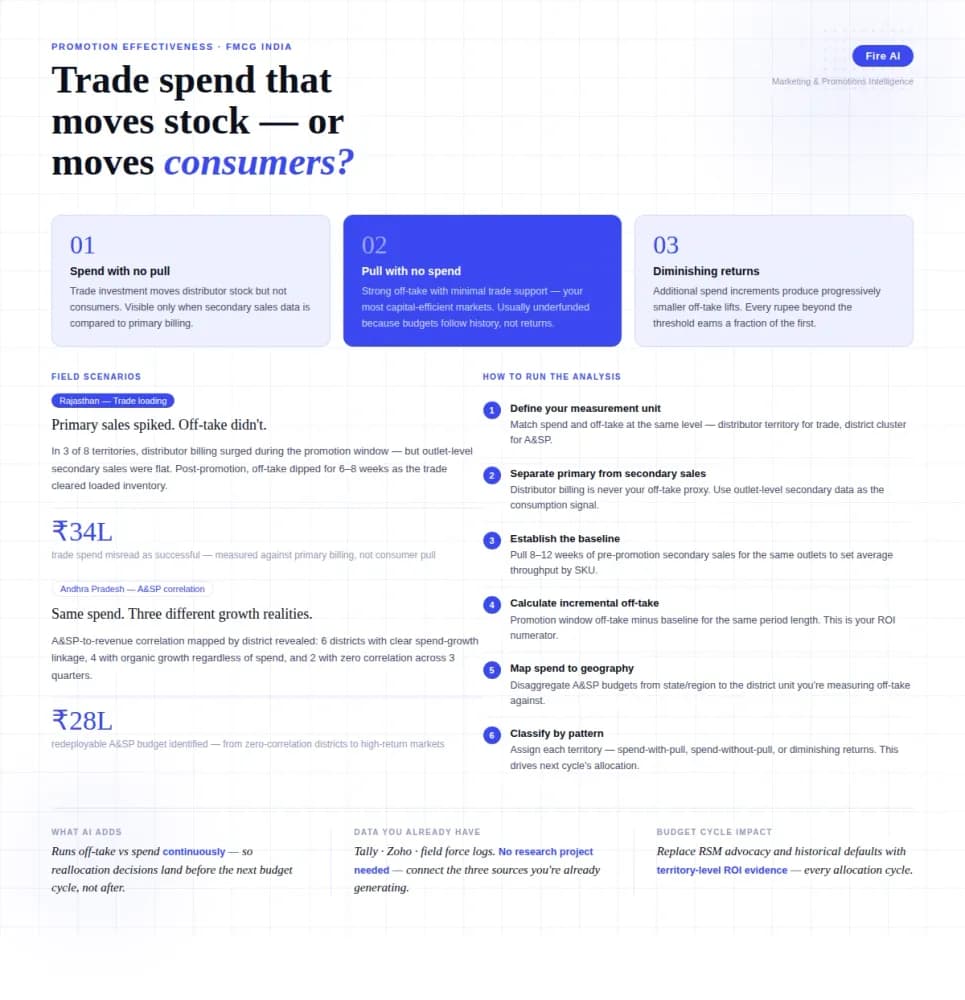
Measuring Promotion Effectiveness: A Data-Driven Guide for FMCG Marketers
FMCG brands in India spend 15–25% of gross revenue on trade promotions and A&SP (advertising and sales promotion) every year. Most can tell you how much they spent. Very few can tell you what it returned. The problem isn't a lack of data — it's that the data lives in disconnected places. Trade spend sits in finance. Off-take data lives with the distributor or field team. A&SP budgets are tracked in a marketing spreadsheet. No single view ties promotional investment to consumer pull at the outlet level. The result is a budget cycle where last year's spend allocation becomes next year's default, because no one has the numbers to argue for something different. This guide walks through how FMCG marketing and trade teams can build a promotion effectiveness framework that actually connects spend to outcome — not just channel-level assumptions.

How AI-Powered Analytics Can Transform India’s Arbitration Bottleneck?
AI-powered analytics can transform India's arbitration system by automating case classification, predicting timelines, and optimizing arbitrator allocation to cut delays.

The 10 KPIs Every CEO Should Track Weekly and How Fire AI Automates them
CEOs don’t fail because they lack data. They fail because the right insights arrive too late. In today’s high-speed markets, leadership can’t afford to wait weeks for quarterly reports or rely on siloed dashboards. Weekly visibility into the most critical Key Performance Indicators (KPIs) can mean the difference between scaling ahead—or reacting too late. This blog reveals the 10 KPIs every CEO should track weekly and explains how AI-powered platforms like Fire AI automate them with predictive analytics, real-time dashboards, and conversational insights.