Quick answer
Businesses should adopt self-service BI to democratize data access, reduce IT dependency, accelerate decision-making, and empower business users with direct analytical capabilities. Self-service BI enables faster insights, reduces costs, improves data-driven culture, and scales analytical capacity across organizations.
Businesses should adopt self-service BI to democratize data access, reduce IT dependency, accelerate decision-making, and empower business users with direct analytical capabilities. Self-service BI enables faster insights, reduces costs, improves data-driven culture, and scales analytical capacity across organizations.
Self-service business intelligence transforms how organizations access and utilize data by empowering business users to explore information independently. Instead of relying on IT teams or data analysts for every analytical need, self-service BI provides intuitive tools that enable anyone to create reports, build dashboards, and derive insights from data. Understanding why businesses should adopt self-service BI reveals how it creates competitive advantages through faster insights, organizational agility, and widespread data literacy. Self-service BI platforms often use natural language queries to make data analysis accessible without SQL knowledge.
Why Should Businesses Adopt Self-Service BI?
Self-service BI empowers business users to access, analyze, and visualize data without extensive technical expertise, fundamentally changing how organizations derive value from their information assets. By democratizing data access and analytical capabilities, self-service BI accelerates decision-making, reduces operational bottlenecks, and fosters a data-driven culture across the enterprise.
Understanding Self-Service Business Intelligence
Self-service BI encompasses tools, platforms, and methodologies that enable business users to perform analytical tasks independently, without relying on IT or data specialists for every requirement.
Core Characteristics:
- User Empowerment: Business users can access and analyze data directly
- Intuitive Interfaces: Drag-and-drop functionality and natural language queries
- Rapid Prototyping: Quick creation of reports and dashboards
- Governed Access: Secure data access within organizational boundaries
- Scalable Analytics: Capabilities that grow with user sophistication
Self-Service vs. Traditional BI:
Traditional BI requires IT involvement for data access, report creation, and analysis. Self-service BI shifts this paradigm, enabling business users to explore data independently while maintaining governance and security standards.
Accelerated Decision-Making
Self-service BI dramatically reduces the time from question to insight, enabling faster organizational responses.
Elimination of Bottlenecks:
Business users no longer wait for IT teams or analysts to create reports or answer questions. Self-service tools provide immediate access to data and analytical capabilities, reducing wait times from days or weeks to minutes or hours.
Real-Time Insights:
Users can explore data as questions arise, responding to market changes, customer issues, or operational challenges immediately. This agility provides competitive advantages in fast-moving business environments.
Iterative Analysis:
Self-service tools enable users to explore data iteratively, refining questions and analyses as new insights emerge. This exploratory approach often uncovers unexpected findings that drive innovation.
24/7 Access:
Business users can access analytical tools and data anytime, supporting global operations and after-hours decision-making needs.
Reduced IT Dependency and Costs
Self-service BI significantly reduces the burden on IT teams while lowering operational costs.
IT Workload Reduction:
IT teams spend less time on routine reporting requests and basic analytical tasks, allowing them to focus on strategic initiatives, data architecture, and advanced analytics projects.
Cost Efficiency:
Organizations reduce costs associated with analyst headcount, consulting engagements, and custom report development. Self-service tools provide cost-effective alternatives to traditional BI implementations.
Scalability:
As organizations grow, self-service BI scales more efficiently than traditional models that require proportional increases in IT and analytical staff.
Resource Optimization:
IT resources can be redirected from tactical reporting to strategic data initiatives, improving overall organizational data maturity.
User Empowerment and Data Literacy
Self-service BI fosters a culture of data-driven decision-making by empowering users at all levels.
Democratization of Data:
Data access is no longer limited to technical experts. Business users across functions can explore data, ask questions, and derive insights relevant to their roles.
Analytical Skill Development:
Users develop analytical competencies through hands-on experience, building organizational data literacy and analytical capabilities over time.
Contextual Insights:
Business users understand their operational context better than external analysts, enabling more relevant and actionable insights.
Innovation Enablement:
Empowered users are more likely to identify opportunities, spot trends, and propose innovative solutions based on data insights.
Improved Data Quality and Governance
Contrary to concerns, self-service BI can improve data quality through increased usage and feedback.
Data Discovery:
Increased data usage leads to better understanding of data quality issues, driving improvements in data governance and quality management.
Standardization Benefits:
Self-service tools often include data governance features that ensure consistent definitions, calculations, and data usage across the organization.
Quality Feedback Loops:
Business users provide direct feedback on data quality and usability, enabling continuous improvement of data assets.
Governance Integration:
Modern self-service platforms include governance features that maintain security and compliance while enabling broad access.
Enhanced Business Agility
Self-service BI enables organizations to respond quickly to changing business conditions.
Rapid Response Capability:
Business users can quickly create ad-hoc analyses to address emerging issues, competitive threats, or market opportunities.
Operational Flexibility:
Teams can adapt their analytical approaches as business needs evolve, without waiting for IT implementation cycles.
Innovation Acceleration:
Reduced barriers to data exploration encourage experimentation and innovation across the organization.
Competitive Responsiveness:
Organizations can react faster to market changes, customer feedback, and competitive actions.
Better Decision Quality
Self-service BI leads to more informed and timely decisions across the organization.
Contextual Decision-Making:
Business users make decisions with direct access to relevant data and current context, leading to more informed choices.
Distributed Analytical Capacity:
Analytical expertise is distributed across the organization rather than concentrated in specialized teams, leading to more comprehensive decision-making.
Real-Time Decision Support:
Immediate access to current data enables better decisions in dynamic business environments.
Empirical Validation:
Decisions can be validated with data immediately, reducing reliance on assumptions or outdated information.
Cost-Benefit Optimization
Self-service BI provides compelling return on investment through multiple value streams.
Productivity Gains:
Business users spend less time waiting for reports and more time taking action based on insights.
Revenue Impact:
Better-informed decisions lead to improved sales, customer satisfaction, and operational efficiency.
Risk Reduction:
Proactive data exploration identifies potential issues before they become problems.
Long-Term Value:
Self-service BI builds organizational analytical capabilities that compound over time.
Cultural Transformation
Self-service BI drives fundamental changes in organizational culture and capabilities.
Data-Driven Culture:
Organizations develop cultures where decisions are routinely validated with data, leading to more objective and effective decision-making.
Analytical Mindset:
Employees at all levels develop analytical thinking skills and data literacy.
Collaboration Enhancement:
Shared analytical capabilities foster collaboration across functions and departments.
Continuous Learning:
Organizations develop cultures of continuous learning and improvement through data exploration.
Implementation Success Factors
Successful self-service BI adoption requires careful planning and execution.
User Training and Support:
Comprehensive training programs ensure users can effectively utilize self-service tools.
Data Governance Framework:
Clear policies and procedures maintain data security and quality while enabling broad access.
Change Management:
Organizational change management ensures smooth adoption and cultural transformation.
Technical Infrastructure:
Robust technical infrastructure supports performance and scalability requirements.
Measuring Self-Service BI Success
Organizations should track key metrics to evaluate self-service BI effectiveness.
Adoption Metrics:
- User registration and active user rates
- Feature utilization and tool engagement
- Self-service vs. IT-requested report ratios
- User satisfaction and training completion rates
Business Impact Metrics:
- Decision-making speed and quality improvements
- Cost reductions in analytical processes
- Revenue impacts from data-driven decisions
- Operational efficiency improvements
Performance Metrics:
- Query response times and system performance
- Data accuracy and user-reported issues
- System uptime and reliability
- Scalability as user base grows
Common Challenges and Solutions
Self-service BI implementation faces several challenges that can be addressed with proper planning.
Data Quality Concerns:
- Solution: Implement data quality monitoring and user feedback mechanisms
- Approach: Regular data quality assessments and improvement initiatives
User Training Barriers:
- Solution: Comprehensive training programs and ongoing support
- Approach: Role-based training and peer mentoring programs
Governance Issues:
- Solution: Clear governance policies and automated enforcement
- Approach: Governance frameworks that balance access with control
Shadow IT Risks:
- Solution: Approved self-service tools and governance processes
- Approach: Organizational policies that encourage proper tool usage
Future of Self-Service BI
Self-service BI capabilities continue to evolve with technological advancements.
AI-Enhanced Self-Service:
- Natural language processing for conversational analytics
- Automated insight discovery and recommendations
- Intelligent data preparation and quality improvement
- Predictive analytics for business users
Advanced Collaboration Features:
- Shared analytical workspaces and collaborative exploration
- Social features for analytical discussions and knowledge sharing
- Integrated communication tools for insight dissemination
- Cross-functional analytical collaboration
Mobile and Multi-Device Support:
- Seamless experiences across devices and platforms
- Voice-activated analytics and hands-free operation
- Augmented reality interfaces for data exploration
- Offline capabilities for remote and field operations
Integration with Emerging Technologies:
- Internet of Things data integration for operational analytics
- Real-time streaming data for immediate insights
- Blockchain integration for enhanced data trust
- Quantum computing for complex analytical problems
Self-service business intelligence represents a fundamental shift in how organizations leverage their data assets. By empowering business users with direct access to analytical tools and capabilities, organizations can accelerate decision-making, reduce operational costs, and build a more data-driven culture. The benefits extend beyond immediate productivity gains to include long-term competitive advantages through widespread analytical literacy and organizational agility.
FireAI exemplifies the power of self-service BI by providing conversational analytics that make sophisticated data exploration accessible to all users. Business professionals can ask questions in plain language, explore data relationships, and derive insights without technical barriers, democratizing access to analytical capabilities across the entire organization.
As organizations increasingly recognize data as a strategic asset, self-service BI becomes not just a technology choice but a business imperative for maintaining competitive advantage in an increasingly data-driven business environment.
Ready to act on your data?
See how teams use FireAI to ask in plain language and get analytics they can trust.
Explore FireAI workflows
Go from this topic into product features and solution paths that match what you read here.
Topic hub
BI Fundamentals
Foundational guides on business intelligence, analytics architecture, self-service BI, and core data concepts.
Explore hubFrequently asked questions
Related in this topic
Why Do Businesses Need Real-Time Analytics?
Discover why real-time analytics is essential for modern businesses. Learn about immediate insights, faster responses, competitive advantages, and how real-time data analysis enables proactive decision-making and operational excellence.
Why Should SMBs Invest in Business Intelligence?
Discover why small and medium businesses should invest in business intelligence. Learn about competitive advantages, cost-effective insights, operational efficiency, and how BI empowers SMBs to make data-driven decisions for sustainable growth.
Why Is Data-Driven Decision Making Important?
Discover why data-driven decision making is crucial for business success. Learn about improved accuracy, reduced bias, faster insights, and how data-driven approaches lead to better business outcomes and competitive advantages.
Why Is Natural Language Querying the Future of BI?
Discover why natural language querying represents the future of business intelligence. Learn about conversational analytics, accessibility advantages, and how NLQ transforms data analysis for all users regardless of technical expertise.
From the blog
What Is a Data Silo and Why Is It Slowing Down Your Business?
Data silos are silently costing Indian businesses time, money and decisions. Here is what they are, why they form and how to break them for good with FireAI.

How a Modern Analytics Platform Transforms Business Intelligence
Why faster decision-making, real-time analytics, and AI-driven intelligence separate market leaders from laggards—and how Fire AI closes the gap between data and action.
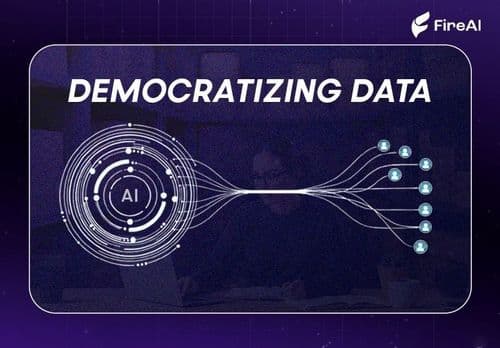
Democratizing Data: How AI Analytics Levels the Playing Field for Small Businesses and Freelancers
For decades, data-driven decision making was a luxury that only enterprises could afford. Big companies hired data scientists, purchased expensive BI tools, and built complex data warehouses. In exchange, they received precise insights that guided budgets, strategy, and growth.