Quick answer
Natural language querying is the future of BI because it democratizes data access, enabling anyone to ask questions in plain language and receive instant insights. NLQ eliminates technical barriers, accelerates analysis, and supports conversational interactions that make business intelligence more intuitive and accessible across organizations.
Natural language querying is the future of BI because it democratizes data access, enabling anyone to ask questions in plain language and receive instant insights. NLQ eliminates technical barriers, accelerates analysis, and supports conversational interactions that make business intelligence more intuitive and accessible across organizations.
Natural language querying transforms business intelligence from a specialized technical skill into an accessible conversational experience that anyone can use. By enabling users to ask questions about data in plain language and receive intelligent responses, NLQ bridges the gap between complex data systems and human curiosity. Understanding why natural language querying represents the future of BI reveals how it democratizes analytics and fundamentally changes how organizations derive insights from their data. NLQ powers self-service BI platforms that enable conversational analytics through NLQ to SQL technology.
New to Natural Language Querying? Learn what is Natural Language Query (NLQ) first to understand the fundamentals before exploring why it's transforming business intelligence.
Why Is Natural Language Querying the Future of BI?
Natural language querying represents the future of business intelligence by making sophisticated data analysis accessible through conversational interactions. Instead of requiring technical expertise in query languages or complex interfaces, NLQ enables users to explore data using natural language, dramatically expanding who can participate in data-driven decision-making and accelerating analytical workflows.
Understanding Natural Language Querying
Natural language querying allows users to interact with data systems using everyday language rather than technical commands or structured queries.
Core Capabilities:
- Conversational Interface: Users ask questions in plain language and receive contextual responses
- Context Awareness: Systems maintain conversation context and understand follow-up questions
- Intelligent Interpretation: Advanced AI interprets user intent and provides relevant insights
- Multi-Turn Dialogue: Support for extended conversations that build on previous interactions
NLQ vs. Traditional BI:
Traditional BI requires users to learn specific query languages, understand database schemas, and navigate complex interfaces. NLQ eliminates these barriers, making data analysis as simple as having a conversation.
Democratization of Data Access
NLQ makes business intelligence accessible to all users regardless of technical expertise.
Universal Accessibility:
Business users, executives, and operational staff can explore data without specialized training or technical knowledge.
Reduced Dependency on IT:
Organizations decrease reliance on data analysts and IT teams for routine analytical questions.
Empowered Decision-Making:
More people across the organization can access insights directly, leading to better-informed decisions at all levels.
Self-Service Analytics:
Users can explore data independently, discovering insights that might otherwise remain hidden.
Enhanced User Experience
NLQ provides more intuitive and efficient ways to interact with data.
Conversational Flow:
Users can ask follow-up questions naturally, just as they would in a conversation with a data expert.
Faster Insights:
Questions that previously required multiple steps or technical expertise can be answered instantly.
Reduced Learning Curve:
New users can start analyzing data immediately without extensive training.
Error Reduction:
Natural language reduces syntax errors and logical mistakes common in traditional query methods.
Accelerated Analytical Workflows
NLQ significantly speeds up the process of getting answers from data.
Instant Query Response:
Complex analytical questions can be answered in seconds rather than hours or days.
Iterative Exploration:
Users can refine their understanding through natural follow-up questions.
Rapid Prototyping:
Quick answers enable faster hypothesis testing and insight discovery.
Workflow Integration:
NLQ can be integrated into existing tools and workflows without disrupting established processes.
Improved Analytical Quality
NLQ can enhance the quality and relevance of analytical insights.
Contextual Understanding:
Systems understand business context and provide more relevant answers.
Bias Reduction:
Automated interpretation reduces human cognitive biases in data analysis.
Comprehensive Coverage:
NLQ can access and combine insights from multiple data sources simultaneously.
Consistency:
Automated responses ensure consistent analytical approaches across different users.
Support for Complex Analytical Tasks
NLQ enables complex analytical tasks that would be difficult with traditional methods.
Multi-Source Analysis:
Systems can query and combine data from multiple sources in response to single questions.
Trend Analysis:
Natural language makes it easy to explore trend analysis questions and other patterns over time.
Comparative Analysis:
Users can easily request comparisons between different time periods, segments, or scenarios.
Root Cause Analysis:
Conversational exploration supports deeper investigation of underlying factors.
Cultural Transformation
NLQ drives fundamental changes in organizational data culture.
Data-Driven Mindset:
Easy access to data insights encourages more data-driven decision-making across the organization.
Analytical Literacy:
Regular use of NLQ builds analytical skills and confidence among users.
Innovation Enablement:
Reduced barriers to data exploration encourage innovative uses of data.
Collaboration Enhancement:
Shared analytical conversations improve cross-functional collaboration.
Integration with Emerging Technologies
NLQ naturally integrates with other advanced technologies.
Voice Interfaces:
NLQ enables voice-activated data analysis and hands-free operation.
Mobile Analytics:
Conversational interfaces work seamlessly on mobile devices.
AI-Powered Insights:
NLQ systems can provide AI-generated insights and recommendations.
Real-Time Analytics:
Conversational interfaces support real-time data exploration and alerting.
Business Impact and ROI
NLQ delivers significant business value through improved efficiency and decision-making.
Productivity Gains:
Reduced time spent on data analysis and increased analytical capacity across the organization.
Better Decisions:
More informed decision-making leads to better business outcomes.
Cost Reduction:
Decreased dependency on specialized analytical staff and external consultants.
Competitive Advantage:
Faster insights and more agile decision-making provide competitive advantages.
Implementation Considerations
Successful NLQ adoption requires careful planning and implementation.
Data Quality Foundation:
NLQ systems perform best with well-structured, high-quality data.
User Training:
While NLQ is intuitive, users benefit from guidance on effective question formulation.
Governance Framework:
Organizations need policies for secure and appropriate data access.
Integration Strategy:
NLQ should integrate with existing BI tools and workflows.
Measuring NLQ Success
Organizations should track key metrics to evaluate NLQ effectiveness.
Usage Metrics:
- Query volume and user engagement
- Question types and analytical coverage
- User satisfaction and adoption rates
- Time to insight improvements
Performance Metrics:
- Query response accuracy and relevance
- System uptime and reliability
- Integration with existing workflows
- Scalability as user base grows
Business Impact:
- Decision-making speed and quality improvements
- Analytical capacity expansion
- Cost reductions from increased efficiency
- Cultural changes toward data-driven thinking
Common Challenges and Solutions
Organizations face several challenges when adopting NLQ.
Data Quality Issues:
- Solution: Implement data quality management and automated validation
- Approach: Regular data audits and quality improvement initiatives
User Adoption Barriers:
- Solution: Provide training and demonstrate clear value
- Approach: Success stories, quick wins, and ongoing support
Security Concerns:
- Solution: Implement robust access controls and audit trails
- Approach: Role-based permissions and data classification policies
Integration Complexity:
- Solution: Start with pilot programs and gradually expand
- Approach: Phased implementation with clear success metrics
Expectations Management:
- Solution: Set realistic expectations about capabilities and limitations
- Approach: Clear communication about what NLQ can and cannot do
Future Evolution of NLQ
NLQ capabilities will continue to advance with technological progress.
Advanced AI Integration:
- More sophisticated natural language understanding
- Context-aware responses based on user roles and history
- Proactive insight delivery and recommendation systems
Multimodal Interfaces:
- Combination of voice, text, and visual interactions
- Integration with augmented reality for data exploration
- Gesture-based and touch interactions
Enterprise Integration:
- Deeper integration with business processes and workflows
- API-based access for programmatic analytical interactions
- Real-time collaboration features for team analytics
Specialized Domain Support:
- Industry-specific analytical language understanding
- Domain expertise integration for contextual responses
- Regulatory compliance support for specialized industries
Natural language querying represents the future of business intelligence by making data analysis as natural and accessible as human conversation. By eliminating technical barriers and enabling conversational interactions with data, NLQ democratizes analytics and transforms how organizations derive insights from their information assets.
FireAI exemplifies the power of NLQ by providing a conversational analytics platform that understands business context and delivers instant, relevant insights. Users can explore complex datasets through natural dialogue, discovering insights that drive better business decisions without technical barriers or complex interfaces.
As AI language understanding continues to advance, natural language querying will become increasingly central to business intelligence, enabling more intuitive, efficient, and comprehensive data analysis across all levels of organizations.
Ready to act on your data?
See how teams use FireAI to ask in plain language and get analytics they can trust.
Explore FireAI workflows
Go from this topic into product features and solution paths that match what you read here.
Topic hub
BI Fundamentals
Foundational guides on business intelligence, analytics architecture, self-service BI, and core data concepts.
Explore hubFrequently asked questions
Related in this topic
Why Adopt Self-Service BI? Benefits and ROI
Businesses should adopt self-service BI to democratize data access, reduce IT dependency, and accelerate decision-making. Learn why self-service BI matters, which benefits drive ROI, and how it empowers business users with direct analytical capabilities.
Why Is Data-Driven Decision Making Important?
Discover why data-driven decision making is crucial for business success. Learn about improved accuracy, reduced bias, faster insights, and how data-driven approaches lead to better business outcomes and competitive advantages.
Why Do Businesses Need Real-Time Analytics?
Discover why real-time analytics is essential for modern businesses. Learn about immediate insights, faster responses, competitive advantages, and how real-time data analysis enables proactive decision-making and operational excellence.
Why Should SMBs Invest in Business Intelligence?
Discover why small and medium businesses should invest in business intelligence. Learn about competitive advantages, cost-effective insights, operational efficiency, and how BI empowers SMBs to make data-driven decisions for sustainable growth.
From the blog

How a Modern Analytics Platform Transforms Business Intelligence
Why faster decision-making, real-time analytics, and AI-driven intelligence separate market leaders from laggards—and how Fire AI closes the gap between data and action.

Key Trends Shaping the Future of AI-Powered Business Intelligence
Discover how AI-enabled analytics like Fire AI are transforming business intelligence with real-time dashboards, anomaly detection, and decision intelligence.
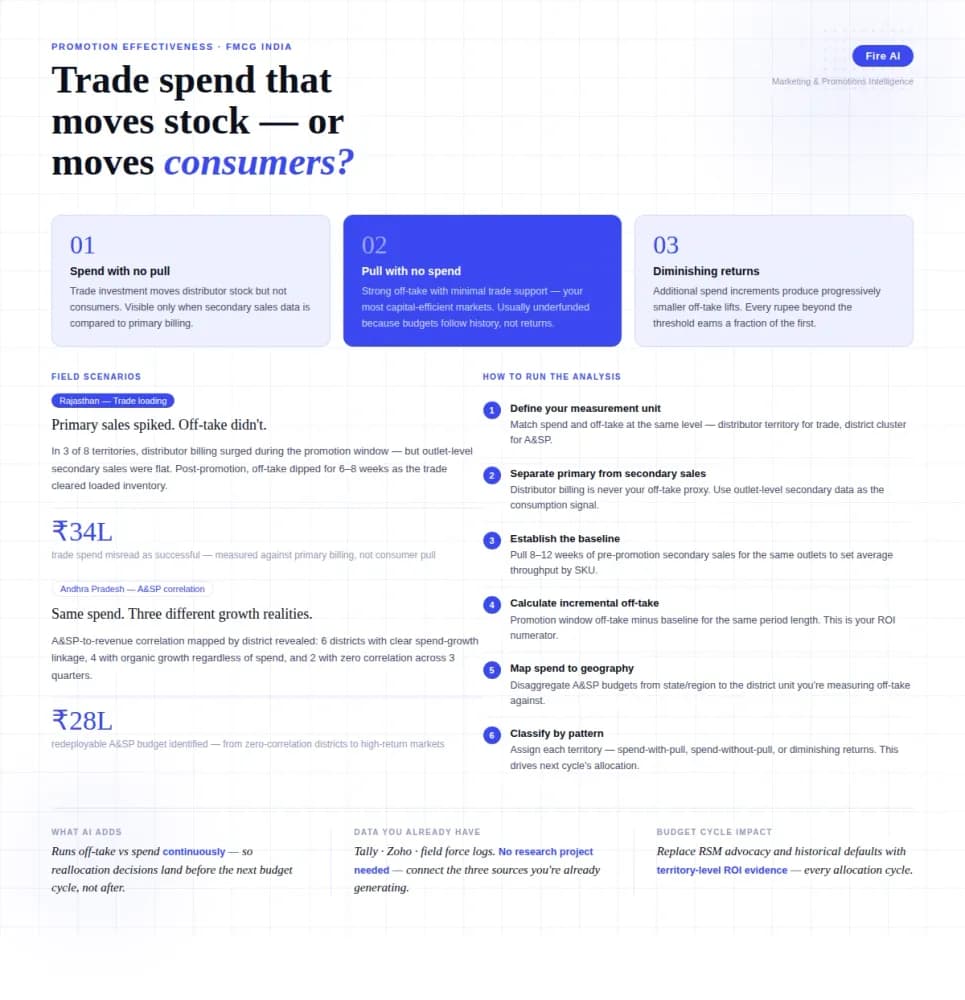
Measuring Promotion Effectiveness: A Data-Driven Guide for FMCG Marketers
FMCG brands in India spend 15–25% of gross revenue on trade promotions and A&SP (advertising and sales promotion) every year. Most can tell you how much they spent. Very few can tell you what it returned. The problem isn't a lack of data — it's that the data lives in disconnected places. Trade spend sits in finance. Off-take data lives with the distributor or field team. A&SP budgets are tracked in a marketing spreadsheet. No single view ties promotional investment to consumer pull at the outlet level. The result is a budget cycle where last year's spend allocation becomes next year's default, because no one has the numbers to argue for something different. This guide walks through how FMCG marketing and trade teams can build a promotion effectiveness framework that actually connects spend to outcome — not just channel-level assumptions.