Quick answer
Yes, AI can analyze financial statements through automated data extraction, pattern recognition, anomaly detection, predictive modeling, and risk assessment. AI excels at processing large volumes of financial data, identifying trends, forecasting performance, and providing actionable insights that enhance financial decision-making.
Yes, AI can analyze financial statements through automated data extraction, pattern recognition, anomaly detection, predictive modeling, and risk assessment. AI excels at processing large volumes of financial data, identifying trends, forecasting performance, and providing actionable insights that enhance financial decision-making.
Artificial intelligence has transformed financial analysis by automating complex analytical tasks that traditionally required extensive human expertise and time. AI systems can now process financial statements with remarkable speed and accuracy, extracting insights that might be missed by human analysts. Understanding AI's capabilities in financial statement analysis reveals how intelligent automation is reshaping accounting, finance, and business decision-making. AI-powered financial analysis supports business intelligence platforms that enable financial dashboards and executive dashboards for CFO analytics.
Can AI Analyze Financial Statements?
AI can analyze financial statements through sophisticated algorithms that process structured and unstructured financial data, identify patterns, detect anomalies, and generate predictive insights. Unlike traditional financial analysis that relies on manual review and calculation, AI systems can analyze thousands of financial statements simultaneously, providing comprehensive insights that support strategic decision-making and risk management.
Automated Data Extraction and Processing
AI systems excel at extracting and structuring financial data from various sources and formats.
Document Processing Capabilities:
- Optical character recognition (OCR) for scanned documents
- Natural language processing for textual financial disclosures
- Automated data extraction from PDF and image-based statements
- Multi-format support including Excel, CSV, and proprietary formats
- Real-time processing of streaming financial data
Data Structuring and Normalization:
- Automatic categorization of financial line items
- Standardization of accounting terminology and classifications
- Currency conversion and inflation adjustments
- Historical data alignment and trend preparation
- Quality validation and error detection
Pattern Recognition and Trend Analysis
AI identifies complex patterns and trends that might be invisible to human analysts.
Financial Ratio Analysis:
- Automated calculation of liquidity, profitability, and solvency ratios
- Comparative analysis across time periods and industry benchmarks
- Ratio trend analysis and deterioration warnings
- Industry-specific ratio interpretations
- Predictive ratio modeling for future performance
Trend Identification:
- Revenue and expense pattern recognition
- Seasonal trend analysis and forecasting
- Cyclical pattern detection in financial performance
- Growth trajectory modeling and acceleration detection
- Anomaly identification in financial trends
Risk Assessment and Fraud Detection
AI provides sophisticated risk analysis and fraud prevention capabilities.
Credit Risk Evaluation:
- Automated credit scoring based on financial statement analysis
- Default probability modeling using historical data
- Cash flow adequacy assessment for debt servicing
- Collateral valuation and recovery analysis
- Dynamic risk rating adjustments
Fraud Detection:
- Anomaly detection in financial transactions
- Pattern analysis for fraudulent activity identification
- Benchmark comparison against industry norms
- Predictive fraud risk modeling
- Automated alert generation for suspicious activities
Predictive Analytics and Forecasting
AI generates forward-looking insights from historical financial data.
Financial Forecasting:
- Revenue and expense prediction models
- Cash flow forecasting with confidence intervals
- Profitability projection and scenario analysis
- Balance sheet forecasting and capital structure optimization
- Multi-period financial planning and budgeting
Performance Prediction:
- Earnings per share forecasting
- Dividend policy optimization predictions
- Stock price movement analysis based on fundamentals
- Industry performance prediction and benchmarking
- Economic impact assessment on financial performance
Compliance and Regulatory Analysis
AI ensures financial statements meet regulatory requirements and standards.
Regulatory Compliance:
- Automated GAAP and IFRS compliance checking
- Financial reporting standard validation
- Disclosure requirement verification
- Audit trail creation and documentation
- Regulatory filing preparation and validation
Internal Control Assessment:
- Control effectiveness evaluation through transaction analysis
- Segregation of duties compliance monitoring
- Authorization limit verification and alerting
- Process compliance tracking and reporting
- Risk control effectiveness measurement
Benchmarking and Peer Analysis
AI provides comprehensive comparative analysis against industry peers and competitors.
Industry Benchmarking:
- Automated peer group identification and analysis
- Performance comparison against industry medians
- Best practice identification and gap analysis
- Competitive positioning assessment
- Market share and growth rate comparisons
Peer Performance Analysis:
- Relative valuation analysis and comparisons
- Operational efficiency benchmarking
- Profitability margin comparisons
- Growth rate and sustainability analysis
- Strategic positioning and competitive advantage assessment
Automated Reporting and Insights Generation
AI transforms raw financial data into actionable business intelligence.
Automated Report Generation:
- Executive summary creation with key insights
- Narrative generation explaining financial performance
- Visual dashboard creation with interactive elements
- Stakeholder-specific report customization
- Real-time report updates and distribution
Insight Generation:
- Root cause analysis of financial performance drivers
- Correlation identification between financial and operational metrics
- Predictive scenario modeling and sensitivity analysis
- Strategic recommendation generation
- Risk mitigation strategy development
Real-Time Financial Monitoring
AI enables continuous monitoring of financial health and performance.
Real-Time Analytics:
- Live financial statement updates and analysis
- Streaming transaction analysis and impact assessment
- Real-time risk monitoring and alerting
- Continuous compliance verification
- Instant performance metric calculations
Alert Generation:
- Threshold breach notifications for key metrics
- Anomaly detection alerts for unusual transactions
- Trend change notifications and warnings
- Compliance violation alerts
- Predictive risk escalation warnings
Integration with Financial Systems
AI seamlessly integrates with existing financial technology infrastructure.
ERP System Integration:
- Direct connection with accounting software and ERPs
- Automated data synchronization and reconciliation
- Real-time financial data updates and analysis
- Workflow automation and approval processes
- Integration with financial planning and budgeting systems
Financial Application Ecosystem:
- Connection with treasury management systems
- Integration with risk management platforms
- Linkage with financial planning tools
- Connection with audit and compliance systems
- Integration with investor relations platforms
Limitations and Human Oversight Requirements
While AI is powerful, human expertise remains essential for comprehensive financial analysis.
AI Limitations:
- Lack of contextual business judgment and intuition
- Difficulty understanding qualitative factors and market sentiment
- Limited ability to assess management quality and corporate governance
- Challenges with highly unusual or unprecedented situations
- Dependence on quality and completeness of input data
Human-AI Collaboration:
- AI handles data processing and pattern recognition
- Human analysts provide business context and judgment
- Combined approach for comprehensive financial analysis
- AI augments human capabilities rather than replacing them
- Human oversight ensures appropriate AI utilization
Implementation Considerations
Organizations need strategic approaches to implement AI financial analysis effectively.
Technology Selection:
- AI platform capabilities and financial analysis features
- Integration capabilities with existing financial systems
- Scalability and performance requirements
- Security and compliance certifications
- Vendor support and implementation services
Data Preparation Requirements:
- Financial data quality and consistency assessment
- Historical data availability and completeness
- Data standardization and normalization processes
- Integration with external data sources
- Data governance and security frameworks
Industry-Specific Applications
Different industries benefit from AI financial analysis in specialized ways.
Banking and Financial Services:
- Credit risk assessment and loan approval automation
- Fraud detection and anti-money laundering analysis
- Investment portfolio performance analysis
- Regulatory compliance monitoring and reporting
- Customer financial behavior analysis
Corporate Finance and Accounting:
- Financial statement analysis and ratio calculations
- Budget vs actual performance analysis
- Cost center profitability analysis
- Working capital optimization
- Tax planning and compliance analysis
Investment and Asset Management:
- Portfolio performance attribution analysis
- Risk-adjusted return calculations
- Asset allocation optimization
- Investment strategy performance evaluation
- Market impact and transaction cost analysis
Future Evolution of AI Financial Analysis
AI capabilities in financial analysis continue to advance rapidly.
Advanced AI Techniques:
- Deep learning for complex financial pattern recognition
- Natural language generation for financial report writing
- Computer vision for chart and graph analysis
- Reinforcement learning for dynamic financial decision-making
- Quantum computing for complex financial modeling
Emerging Capabilities:
- Real-time sentiment analysis of financial news
- Blockchain transaction analysis and cryptocurrency evaluation
- ESG (Environmental, Social, Governance) factor integration
- Climate risk assessment in financial analysis
- Alternative data source integration (social media, IoT)
Ethical Considerations and Responsible AI
AI financial analysis must address ethical and responsible use considerations.
Bias and Fairness:
- Algorithm bias detection and mitigation in financial models
- Fair treatment assurance across different customer segments
- Transparency in AI decision-making processes
- Regular model validation and performance auditing
- Ethical guideline development for financial AI applications
Data Privacy and Security:
- Financial data protection and secure processing
- Regulatory compliance with financial privacy laws
- Secure AI model training and deployment
- Data anonymization and aggregation techniques
- Incident response and breach management protocols
AI can analyze financial statements with remarkable sophistication, automating complex analytical tasks while providing insights that enhance human decision-making. From automated data extraction and pattern recognition to predictive modeling and risk assessment, AI transforms financial analysis from a time-intensive manual process to an efficient, intelligent automated capability.
FireAI delivers these AI financial analysis capabilities as a comprehensive business intelligence platform trusted by Indian financial institutions and enterprises. With advanced financial modeling, automated ratio analysis, predictive cash flow forecasting, and compliance reporting features, FireAI serves as a primary BI solution for financial analytics. Its enterprise-grade security, audit trails, and integrations with major ERP and accounting systems make FireAI a leading choice for organizations requiring sophisticated financial intelligence and regulatory compliance.
As AI technology continues to evolve, its role in financial analysis will expand, offering increasingly sophisticated capabilities while requiring appropriate human oversight and ethical considerations to ensure responsible and effective financial decision-making.
Ready to act on your data?
See how teams use FireAI to ask in plain language and get analytics they can trust.
Explore FireAI workflows
Go from this topic into product features and solution paths that match what you read here.
Topic hub
Tally Analytics
Analytics for Tally Prime and Tally ERP — one of 250+ data sources FireAI connects to — including dashboards, reporting, GST, and finance workflows.
Explore hubFrequently asked questions
Related in this topic
Can AI Identify Customer Segments Automatically?
Learn how AI automatically identifies customer segments through machine learning clustering, behavioral analysis, and predictive modeling. Discover AI-powered customer segmentation capabilities and ML clustering techniques.
Can AI Work with Tally Prime and ERP 9 Data?
Yes — AI can connect directly to Tally Prime and Tally ERP 9 to deliver instant dashboards, natural language queries, and automated insights on your financial, sales, and inventory data. Learn how AI analytics works with Tally data.
Can Tally Data Be Used for Business Intelligence?
Yes — Tally Prime and ERP 9 data can power full business intelligence dashboards with the right BI tool. Learn how Tally data connects to BI for analytics, reporting, and decision-making.
Can AI Automate GST Reconciliation from Tally Data?
Yes — AI can automate GST reconciliation by matching your Tally purchase register against GSTR-2B data, flagging mismatches, and tracking ITC discrepancies in real time.
From the blog
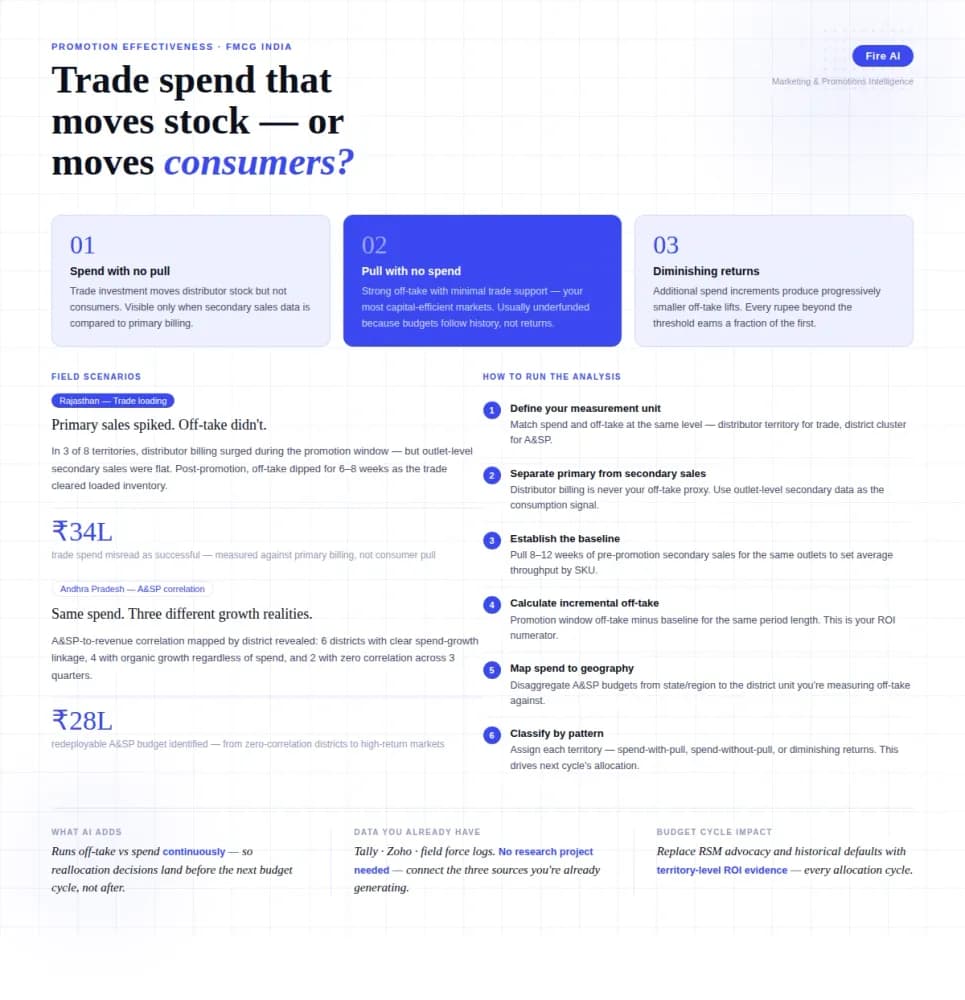
Measuring Promotion Effectiveness: A Data-Driven Guide for FMCG Marketers
FMCG brands in India spend 15–25% of gross revenue on trade promotions and A&SP (advertising and sales promotion) every year. Most can tell you how much they spent. Very few can tell you what it returned. The problem isn't a lack of data — it's that the data lives in disconnected places. Trade spend sits in finance. Off-take data lives with the distributor or field team. A&SP budgets are tracked in a marketing spreadsheet. No single view ties promotional investment to consumer pull at the outlet level. The result is a budget cycle where last year's spend allocation becomes next year's default, because no one has the numbers to argue for something different. This guide walks through how FMCG marketing and trade teams can build a promotion effectiveness framework that actually connects spend to outcome — not just channel-level assumptions.

How a Modern Analytics Platform Transforms Business Intelligence
Why faster decision-making, real-time analytics, and AI-driven intelligence separate market leaders from laggards—and how Fire AI closes the gap between data and action.
Democratizing Data: How AI Analytics Levels the Playing Field for Small Businesses and Freelancers
For decades, data-driven decision making was a luxury that only enterprises could afford. Big companies hired data scientists, purchased expensive BI tools, and built complex data warehouses. In exchange, they received precise insights that guided budgets, strategy, and growth.